
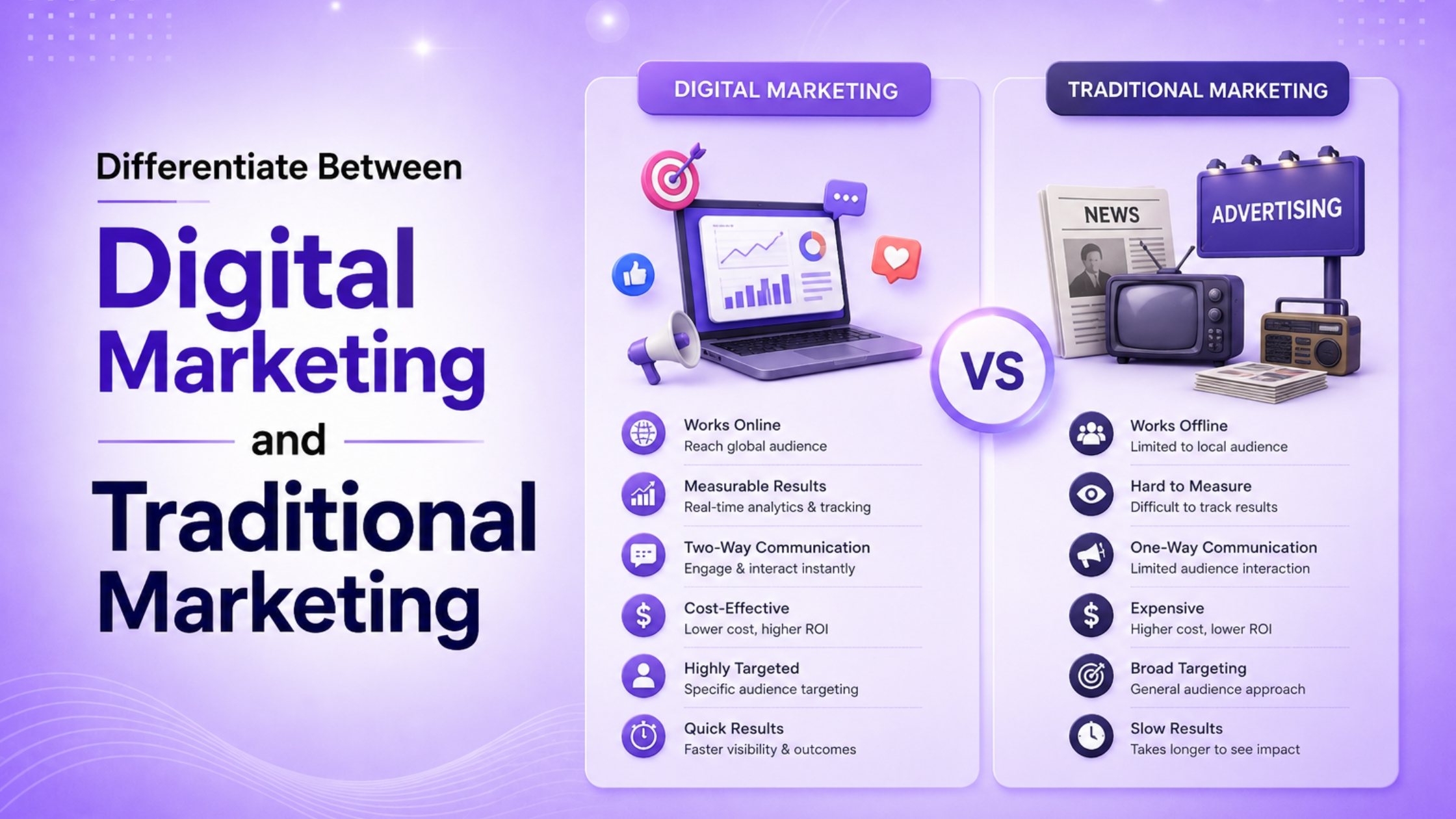
Marketing has always been and will continue to be about getting the right message to the right people. This is where digital vs traditional marketing comes in. The tools, channels, and budgets shift over time, but the goal remains the same. One of the biggest changes in the past 20 years has been the methods used to connect with their audience.
This isn’t a debate where one side wins and the other disappears. It’s a discussion of audience, budget, goals, and fit. When you’re building a brand or running a business, you must have a clear understanding of both sides.
What is Traditional Marketing?
Any marketing method that doesn’t rely on the internet is considered traditional marketing. Consider TV commercials, radio commercials, newspaper ads, billboards, flyers, cold calling, and direct mail. These methods have been available for many years. And they still work particularly to reach those who don’t live in the palm of their hand!
A billboard is located by a busy road and is viewed by thousands of people each day. A local ad in the newspaper can realistically generate customers who will come through your door. A radio spot is able to get to people when they’re listening.
The problem? It is not possible to measure! You can only speculate about the number of individuals who saw your own hoarding, what they did with it afterwards, and if your expenditure was worthwhile.
What is Digital Marketing?
Digital marketing is all activity that occurs online. That includes: Search Engine Optimization (SEO), Social media ad popups, Google Ads, Email campaigns and Influencer and affiliate marketing. The use of WhatsApp and chatbots to create marketing campaigns.
The key element of this is that you can actually see what is going on. Who, where, who did they stay for a long time on your website, and whether they made a purchase. It is all traceable.
It’s also possible to target very specifically. An ad for sports shoes can be displayed only to men aged 18-35, who searched for running shoes last week. This is something that you can’t do with a newspaper ad.
Digital vs Traditional Marketing: Side by Side
For a clearer understanding, let’s make one final comparison:
Factor | Traditional | Digital |
Cost | High, fixed upfront | Flexible, start small |
Reach | Broad but unfocused | Narrow and targeted |
Engagement | One-way only | Two-way conversation |
Measurement | Estimated guesswork | Exact, real-time data |
Flexibility | Hard to change | Adjust anytime |
Speed | Slow results | Fast results |
Best For | Local, older audiences | Online, growth-focused brands |
Why Digital Marketing is a Good Investment for Most Businesses?
As a business owner, digital marketing offers you a lot of control, data, and space for growth, especially if you are running an online business or sell product/services online in 2025.
It’s okay to experiment, learn quickly, make changes when something doesn’t work, and double down when it does. This is not the kind of flexibility that can be found in traditional marketing.
However, having the help of a Best Digital Marketing Agency does make a difference as you either start up or are looking to scale. It takes time to develop a strategy and gain experience with platforms, as well as with campaigns.
Which Marketing Channel is Suitable for Your Business?
When your customer is online, and your budget is limited, begin with digital. For customers who are not as active online, add some of the more traditional approaches. If you can, try both and go with the numbers!
Step 1: Find Your Audience
Know where to find your customers. Online, offline, or a combination of both. This answer is the foundation for all other answers.
Step 2: Design Your Content
Be aware of exactly how much you can afford to pay each month. With Digital, you can get started with just a single step. It’s often a more significant initial investment.
Step 3: Set Your Goal
Do you want to increase brand awareness or have immediate sales? The right channel will be able to produce the desired results more quickly, depending on your goal.
Step 4: Test Before Committing
Don’t make a single, blind buy. Try out a small campaign on each one and determine which one results in better leads or conversions.
Step 5: Decide on Data
Don’t make decisions based on feelings. Check real figures, cost per lead, reach, conversions, and invest more in what works.
Smart Way to Think About Online vs Offline Marketing
When it comes to marketing, there is a distinct difference between online and offline. There is a clear difference between traditional marketing and digital marketing.
Don’t view digital and traditional marketing as an either/or situation. Imagine it’s a toolkit!
Offline marketing is awesome for:
- The long-term process of gaining trust in a brand.
- Engaging older or less active audiences online
- Being in the area of a city/town (vs. being away from the area)
- Events, launches, and physical promotions
Online Marketing benefits:
- Marketing towards a specific type of customer
- Assessing the effectiveness of action and the effectiveness of non-action
- Rising to fame on a dollar budget
- Retargeting is the process of targeting those who already have some interest.
Most brands that are growing use a combination. A large company may display a TV commercial for awareness, and then follow up the initial campaign with a Google commercial to close the deal. There are two different roles that both of these channels perform.
Businesses can make digital campaigns clear, measurable, and focused on real business objectives with NextBigBox, but when your digital presence is taken seriously, you don’t know where to start. It’s about results, not guesstimates or vanity metrics.
Conclusion
It’s simple, online vs offline marketing is all about targeting the right people, at the right time and place. The world’s most successful brands are created through traditional marketing. Digital marketing is now enabling smaller businesses to take on the brands. None are being deleted. The important point is that you select the one that you feel is appropriate for your audience, your objectives, and your budget. Not because it is a way we are used to doing something. Not because everybody else is doing it. It is supported by data and logic.
Frequently Asked Questions
Digital marketing uses online channels with measurable results. Traditional marketing uses offline methods with an estimated reach.
Digital marketing is more cost-effective. You can start small, track results, and scale based on performance.
Absolutely. Digital marketing lets small businesses target the right audience without spending a large upfront budget.
Yes. Traditional marketing still works well for local businesses, older audiences, and building offline brand trust.
Yes. Combining both maximises reach. Traditional builds awareness while digital converts that awareness into actual sales.



Leave a Reply