
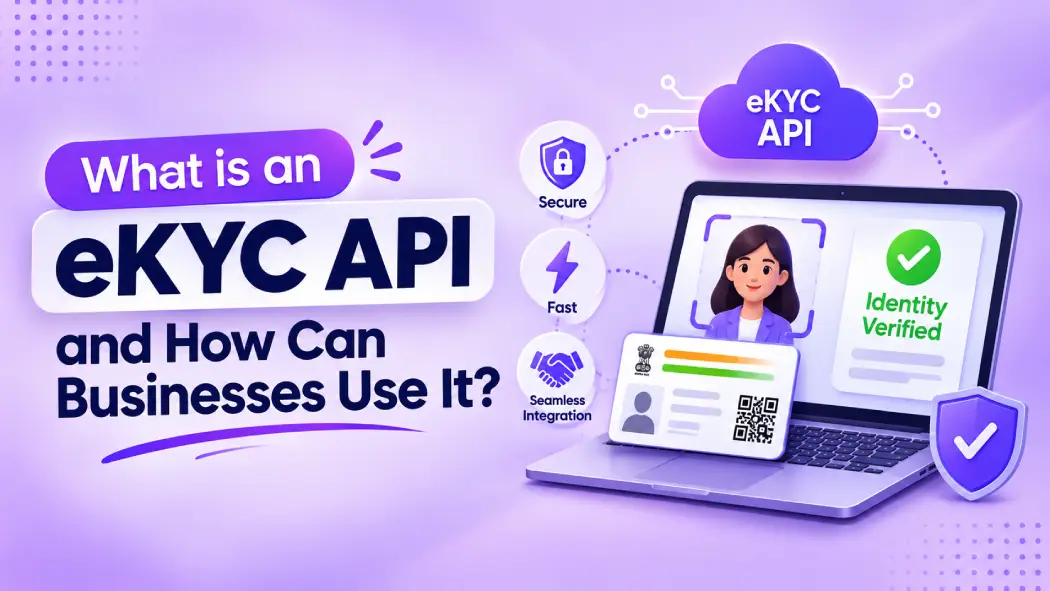
Every business that handles money or sensitive services needs to know who its customer is. In the past, this meant paper forms, photocopies and long waits. Today, many businesses do the same job in a few minutes with an eKYC API.
What is an eKYC API?
eKYC means electronic KYC. It is KYC done through digital methods instead of paper.
API means Application Programming Interface. In simple words, it is a bridge. It lets one software system talk to another and ask for a result.
So an eKYC API is a bridge that lets your app send a customer’s details or documents to a verification service and get back a result, such as “verified”, “not matched” or “needs review”.
Think of it like this. A customer opens your app and enters their PAN. Your app sends it through the API. The API checks the PAN against the official source and sends back the result in seconds. Your customer never has to upload a photocopy or visit a branch.
How Does an eKYC API Work? Step by Step
The exact flow depends on the provider and the checks you choose. A typical flow looks like this:
- The customer starts. They open your app or website and begin sign up.
- You take consent. The customer must be told clearly what data you will use and why, and must agree.
- Your system calls the API. It sends the data needed, such as a PAN, a mobile number, a selfie, or an Aadhaar-based request, depending on the method.
- The provider checks the source. The API connects with the relevant database or service and runs the check.
- You get a response. It usually comes back as a result code and some data fields, such as a name match or a verified status.
- Your rules decide the next step. You approve, reject, or send the case to a person for review.
- You store a record. You keep the audit trail and proof of consent, as required by law, and protect it well.
Common Types of eKYC API Checks
Different checks do different jobs. Most businesses use a mix.
- Aadhaar OTP based eKYC The customer enters their Aadhaar number and a one time password (OTP) is sent to their linked mobile. If it matches, UIDAI shares limited identity details. In India, this is allowed only for entities that are properly authorised, so not every business can use it.
- Offline Aadhaar verification Here, the customer shares a digitally signed Aadhaar XML file or secure QR code. The business checks the signature without needing a live link to UIDAI. For RBI regulated entities, this is an important alternative, especially because the masked Aadhaar can be used.
- DigiLocker based document fetch With the customer’s consent, a business can fetch issued documents such as PAN, driving licence or marksheets from DigiLocker. The documents come from the issuer, so they are more trustworthy than uploaded photos.
- PAN verification This checks whether a PAN is valid and whether the name matches the details the customer gave.
- Face match and liveness check The customer takes a selfie. The system compares it with the photo on the ID and checks that a real, live person is present, not a printed photo or a video replay.
- Bank account verification Often called a “penny drop”. A very small amount is sent to the account to check that the account number and name are correct.
- Video KYC A trained official of the business talks to the customer live on video, checks the documents, location and liveness, and records the session. RBI has set detailed rules for this process, called V CIP (Video based Customer Identification Process). Only entities allowed by RBI can use it.
- CKYC lookup This checks whether the customer already has a KYC record in the central KYC registry, so the customer does not need to repeat the full process.
Who Uses eKYC APIs?
- Banks and NBFCs for account opening and loan onboarding
- Loan and fintech apps to verify borrowers quickly
- Insurance companies to issue policies faster
- Stock brokers and investment platforms to open demat and trading accounts
- Wallets and payment apps for account limits and compliance
- Gig and delivery platforms to check the identity of workers
- Rental, hiring and background check companies to confirm identity before a deal or a job
Note that the method you are allowed to use depends on your industry and licence. A fintech that works with a regulated lender may follow that lender’s KYC process.
Simple Example: A Loan App
Say a customer wants a small personal loan on an app.
- They enter their mobile number and give consent.
- The app verifies the PAN through the API.
- The customer completes identity verification using an allowed method, for example offline Aadhaar or DigiLocker.
- A selfie is matched with the ID photo and a liveness check is done.
- The bank account is verified before the loan is paid in.
- The lender runs its credit checks and gives a decision.
All of this can happen in minutes. Without eKYC, the same process may need photocopies, courier time and manual checking.
Benefits of Using an eKYC API
- Faster onboarding: Customers finish sign up in minutes, so fewer drop off.
- Lower cost: Less paper, fewer branch visits and less manual data entry.
- Fewer errors: Data comes from a source, not from handwriting.
- Better fraud control: Face match, liveness and document checks make fake identity harder.
- Audit trail: Every check can be logged, which helps with audits.
- Better customer experience: Customers can sign up from home at any time.
Rules Businesses in India Should Know
This is a summary only. Always confirm with your compliance team.
- RBI KYC rules (for regulated entities). Banks, NBFCs and other RBI regulated entities must follow the RBI Master Direction on KYC. It covers how to identify customers, how to do video KYC, how often to update KYC and how to keep records. For video KYC, the RBI rules include a live call with an official of the business, recording the session, a liveness check, confirming the customer’s location in India, and keeping the video safe.
- Aadhaar rules. Online Aadhaar authentication, such as OTP based eKYC, is limited to entities that are allowed under the Aadhaar Act and its regulations. This usually means working as an Authentication User Agency (AUA) or KYC User Agency (KUA), or through a licensed KUA as a sub KUA, with the needed approvals. RBI regulated entities may also need to be notified under the PMLA to collect Aadhaar numbers. If you are not eligible, the offline verification route or other allowed documents may be the right path. Check this before you build.
- Data protection law (DPDP Act and Rules). India’s Digital Personal Data Protection Rules, 2025 were notified on 13 November 2025, and the duties come into force in phases. Key ideas for businesses include:
- Give a clear consent notice in plain language that lists the data and the purpose, and tell people how to withdraw consent and complain.
- Use proper security measures such as encryption, masking, access controls and activity logs.
- Report a data breach to affected people and to the Data Protection Board, with a detailed report within 72 hours of becoming aware.
- Delete personal data when the purpose is over or consent is withdrawn, unless a law requires you to keep it. KYC records often have legal retention periods, so check them.
Please confirm the current start dates and your exact duties with a legal expert.
How to Choose a Good eKYC API Provider
Use this checklist when you compare providers.
- Compliance fit: Does the provider support the methods you are legally allowed to use? Ask how it handles Aadhaar rules and RBI rules.
- Security: Ask about encryption, access control, data storage location, security audits and certifications.
- Data handling: Ask what data they store, for how long, and how it is deleted. A provider should not keep more than needed.
- Accuracy and speed: Ask about success rates, response time and uptime. Run a test before you commit.
- Fraud tools: Check the quality of liveness detection and face match.
- Audit logs and reports: You should be able to get proof of each check.
- Support and documentation: Clear docs, test sandbox and quick help when something fails.
- Pricing: Know the cost per call, fees for failed calls, and any minimum commitment.
- Reliable fallback: What happens if a government source is down? Good providers have a plan.
Common Mistakes to Avoid
- Using an Aadhaar method that your business is not allowed to use
- Collecting more data than you need
- Not taking clear consent, or hiding it in long text
- Storing full Aadhaar numbers or photocopies when you do not have to
- Skipping liveness checks, which makes selfie fraud easy
- Having no plan for failed checks, so honest customers get stuck
- Not testing with real devices and slow networks
- Ignoring record retention and deletion rules
Challenges of eKYC
- Network and device problems: Poor camera quality or weak internet can fail a check.
- Name mismatches: Small spelling differences can cause a mismatch. Allow a review path.
- Fraud tricks: Fake documents and deepfakes are a growing risk, so use layered checks.
- Changing rules: Regulations change, so review your process regularly.
- Customer trust: Some people worry about sharing data. Clear, simple notices help.
Simple Steps to Get Started
- Know your legal duties. Ask your compliance team which KYC methods you are allowed to use.
- Map your customer journey. Decide which checks are needed at each step.
- Shortlist providers. Use the checklist above and ask for a demo or sandbox.
- Design consent and privacy notices. Keep them short and clear.
- Test the full flow. Include edge cases such as failed OTPs and name mismatches.
- Set up monitoring and manual review for risky or unclear cases.
- Train your team and prepare a plan for data breaches.
- Review regularly as rules and fraud methods change.
Conclusion
An eKYC API can help a business onboard customers faster, cut costs and reduce fraud. But speed should never come before safety and law. Choose only the methods you are allowed to use, take clear consent, protect personal data, and pick a provider you can trust. With the right setup, eKYC can build a smooth and safe experience for both your business and your customers.
Frequently Asked Questions
It stands for electronic Know Your Customer. It means confirming a person’s identity online using photos, documents, and database checks instead of paperwork in person.
Banks and other regulated sectors can use approved eKYC methods under certain conditions. Rules change over time, so check with your regulator or legal adviser.
Many automatic checks finish in seconds or a few minutes. Cases that need a manual review take longer, depending on your own process.
Compare data safety, supported documents, support quality, and pricing. Test the service with real-looking cases before you sign anything.
That depends on how the service and your business handle it. Look for encryption, limited access, and clear data storage rules, and follow privacy.





Leave a Reply