
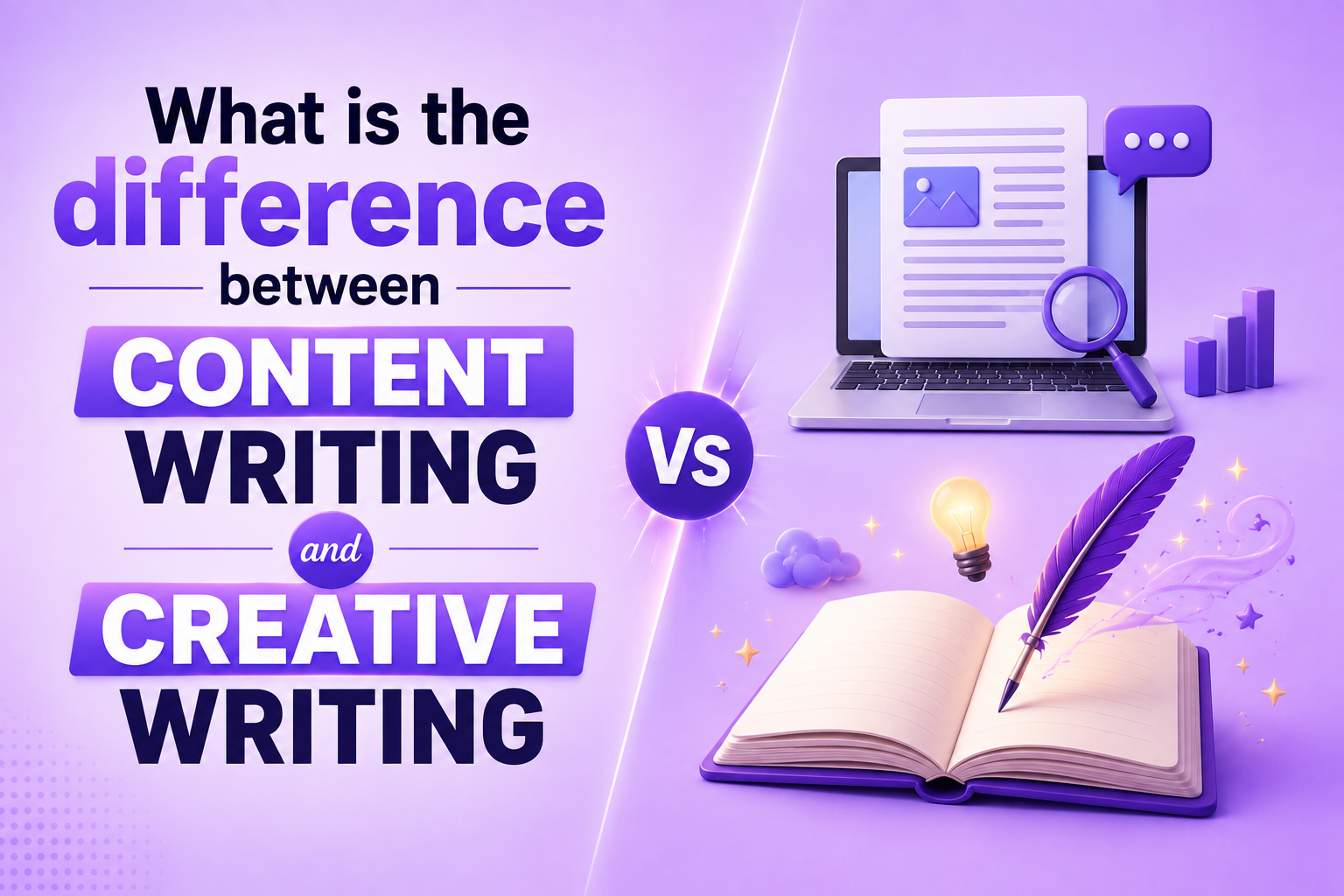
When you ask a writer what type of writer they are, you will get ten different types of answers. Some call themselves content writers. Others will say creative writers. Now, you will say that both of them write; it’s the same thing. But the difference between content writing and creative writing is huge.
If you are someone who is trying to become a writer or hiring one, then understanding the difference between these two is a must. Writers do not just write anything; they do it according to what’s required and specific categories.
What is Content Writing?
Content writing is done to solve problems of the audience who is searching for something specific. Examples are: blogs on skincare or daily diet routines, product descriptions, newsletters, how-to guides for setting up a router, or anything. These types of things fall under content writing. The goal here is to provide information, build trust, and give reliable information so that someone can understand and purchase with clarity.
A content writer works with a brief, a keyword list, a brand voice guide and a deadline. The true personality of a writer shows up in word choice and rhythm, but the core message and structure follow a plan to remain on the goal.
What is Creative Writing?
Creative writing is a type of writing that is non-formal. A writer shares ideas and expresses emotions in words that are not just facts but touch the audience’s heart. The types of creative writing are: novel, poetry, personal essay, scripts, screenplays, and brand taglines.
There is not a long list of keywords, or sometimes no keywords. Creative writing means it is all about how expressive and imaginative you are. For example, a brand tagline tells the whole story of it, just in a few words.
Difference Between Content Writing and Creative Writing
The clearest way to see the difference between content writing and creative writing is to line them up against the same set of questions.
Factor | Content Writing | Creative Writing |
Main goal | Inform, rank, or convert | Express, entertain, or move the reader emotionally |
Audience | A defined reader persona or search intent | Often the writer’s own imagination or a general reader |
Structure | Follows a brief, outline, or SEO format | Flexible, can break convention on purpose |
Success metric | Traffic, clicks, engagement, sales | Emotional impact, publication, reader response |
Voice | Matches a brand or client | Belongs entirely to the writer |
Timeline | Deadline-driven, often recurring | Can take months or years to finish |
Types of Content Writing
To understand the difference between content writing and creative writing, you need to know what the types of content writing are:
1) Product pages: A page for a blender or a software subscription plan, created to provide answers to buying queries and motivate users towards purchasing.
2) Blog posts: SEO-driven content based on a theme that is being searched online by people, created to teach and rank.
3) Email campaigns: Short and straightforward content that would make the recipient read and click in seconds after receiving an email.
4) Landing pages: Content created on the basis of a single offer, meant to drive the visitor towards performing a specific action.
5) Social media captions: Short, platform-specific text meant to halt scrolling and achieve a marketing purpose.
Types of Creative Writing
Here are some various types of content writing:
1) Short stories: Entire fictional narratives developed around characters and plots, which are published either in magazines, collections, or online literary magazines.
2) Personal essays: It is in the first person about an experience, opinion, or recollection, without the need to sell anything.
3) Poetry: Rhythmical and compact form of literature where the choice of words is just as important as the message conveyed through those words.
4) Screenplays: Fictional dialogues and scenarios used to create films and television series, and developed through a visual form of narrative.
5) Novels: Narrative fiction created during several months and sometimes years of writing.
Common Skills in Content and Creative Writing
It would be wrong to treat these as two unrelated jobs. The best writers in either camp constantly borrow from the other, even if their paycheck comes only from one side:-
- A strong hold on grammar.
- Ability to keep the readers interested even after the first line.
- A novelist who understands structure writes tighter scenes.
- A content writer who understands storytelling writes better case studies.
Tools Worth Trying for Writing: By Budget
- Free tier: Google Docs for drafting, Hemingway Editor for readability checks, and the free version of Grammarly for basic grammar catches.
- Paid tier: Grammarly Premium or ProWritingAid for deeper style feedback, and Scrivener for organizing long fiction or multi-chapter projects.
- Premium tier: Surfer SEO or Clearscope for content writers optimizing for search, and a paid Final Draft license for screenwriters working on industry-standard scripts.
Which Writing To Choose?
If you like research, structure, and seeing measurable results from your writing, content writing will likely suit you better. If you are drawn to invented characters, unusual sentence rhythm, and writing that does not need to justify itself with a conversion rate, creative writing is where you will feel more at home. Plenty of writers do both, using content work to pay the bills while creative projects run in the background.
Frequently Asked Questions
Yes. Many professionals switch between the two depending on the project, though each style requires a different mindset and pace.
Content writing generally offers steadier income, since brands need it constantly. Creative writing income varies widely and often depends on publishing deals or royalties.
No formal degree is required. A strong portfolio, clear writing samples, and familiarity with SEO basics matter far more to most employers.
No. It also includes poetry, personal essays, memoir, and screenwriting. Anything driven by imagination rather than a marketing brief.
Start with whichever format excites you enough to practice daily. Consistency matters more than picking the perfect starting point.



Leave a Reply