
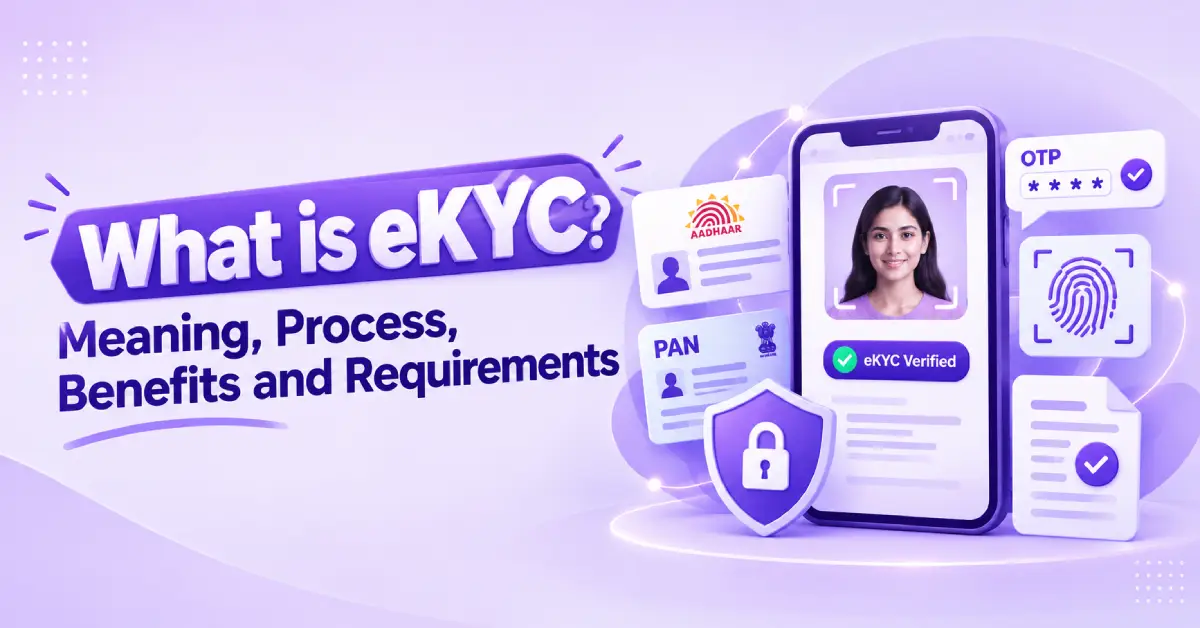
Digital services have changed a lot in the recent time and especially how businesses verify their customers. Manually checking, verifying and visiting physically to the branch are now completely done through the online mode. This process is known as electronic Know Your Customer, or eKYC.
eKYC solution make life easier for customers in terms of onboarding, while for the business, it helps to collect, verify, and record information. The only problem is that the whole process may vary from case to case.
What is eKYC and How Does It Work?
If you are wondering what is eKYC, it is a digital method of collecting and verifying customer identity information during onboarding or other regulated processes.
Depending on the use case, the process may involve identity documents, OTP authentication, biometric checks, facial matching, liveness detection, or information retrieved from an approved source. The customer provides the required details and consent, after which the submitted information is checked through the relevant verification method.
The main difference from a paper-based approach is the way information moves through the process. Digital systems can capture details, perform checks, record outcomes, and pass verified information to the next stage without requiring every step to be handled manually.
Why is eKYC Important for Digital Customer Verification?
There is a requirement to have an approach for authenticating online users’ identities. A customer might apply for some kind of financial products, buy a certain service or create an account or access any regulated platform. This procedure enables organizations to confirm that all data entered belong to a user who completes verification.
Using eKYC solution allows to integrate all verification procedures into one organized flow. It does not require from customers to enter data multiple times and complete unconnected steps, but gives opportunity to organize the whole onboarding process.
It can be especially useful for organizations which process huge amounts of applications. Digital process will also help to manage verification documents according to the organization’s data management policy.
How Does the eKYC Process Work Step by Step?
The exact workflow varies, but a typical digital KYC journey follows several stages.
Step 1: Provide Details
The customer gives basic information, including his name, birth date, address, phone number, and other information that will be needed during the service. The customer’s identity proof can be supplied here.
Step 2: Provide Consent
The customer is briefed on the verification procedure, and he gives his consent wherever needed. It will help to lay the foundation for access to or processing of the required information.
Step 3: Verify Identity
The supplied information is verified using the verification method of your choice. It will depend on the verification process, whether it is OTP verification, document verification, biometric verification, facial match, liveness detection, or others.
Step 4: Perform KYC
Once the needed information is verified, the result of the verification is documented. If the provided information fulfills the requirements, then the customer can continue with the required onboarding process.
Documents Required for eKYC
Here are the most commonly asked documents when doing eKYC:
- Aadhaar Card: For verification of your identity using digital means by using appropriate Aadhaar-based eKYC procedures with your consent.
- PAN Card: Usually needed to verify your PAN details for regulatory purposes while availing of financial services.
- Passport: A passport may also serve as proof of your identity and address, subject to acceptance by the service provider.
- Driving License: A valid driving license is acceptable as an official proof of identity and address.
- Voter ID: Voter’s Identity Card may also serve as proof for conducting KYC verification.
- Photograph: Some digital verifications might require your latest photo or take a live photo during the process.
Benefits of eKYC for Businesses and Customers
A well-designed eKYC solution can affect several parts of the onboarding experience, although the actual benefits depend on implementation and the type of verification being performed.
Faster Onboarding
As the hard paperwork is reduced with the help of digital submissions. This helps eligible customers to move through onboarding more efficiently.
Less Manual Work
Processes can be automated to perform all manual verification tasks, and therefore workers would be free to deal with the exceptions, inquiries, and further assessments.
Remote Verification
It is possible that customers can perform identity verification using their devices and do not have to go to the office.
Consistent Verification
The digital workflow can be used by organizations to perform consistent verification processes for similar applications.
Easy Documentation
Digital identity verification can generate structured documentation of all the submissions, checks, and results.
eKYC vs Traditional KYC: What is the Difference?
Traditional KYC can involve physical documents, manual data entry, branch visits, and face-to-face verification. eKYC moves some or many of these activities into a digital environment.
Factor | Traditional KYC | eKYC |
Customer interaction | Often physical | Primarily digital |
Documents | Physical or scanned | Digital submission or retrieval |
Data entry | More manual | Can be automated or prefilled |
Verification | Manual and physical checks may be involved | Digital checks can be incorporated |
Location | May require branch access | Can support remote journeys |
Records | Paper or scanned records | Digital verification records |
How to Choose the Right eKYC Solution for Your Business?
Selecting an eKYC solution requires more than checking the number of verification features available. NextBigBox provides the service of eKYC, you can visit the website and see the process.
Step 1: Verify Verification
Learn about the verification methods available, and see whether they fit your customers, products, location, and other requirements.
Step 2: Examine Security
Find out how sensitive data is kept secure when being collected, transferred, processed, accessed, and stored during the verification process.
Step 3: Evaluate Integration
See whether the solution can integrate into your website, application, CRM, onboarding system, or any other tools you have without creating unnecessary complexity for you.
Step 4: Conduct Usability Testing
A verification process needs to be easy for the user to understand. Complex instructions, unnecessary actions, and confusing error messages can cause unnecessary friction in onboarding.
Step 5: Analyze Support
Take into account the documentation, technical support, report writing, problem solving, and capacity for supporting your operation.
Is eKYC Safe and Secure?
Certainly, because the security of digital KYC processes largely depends on the technologies, control measures, and processes applied by the organization and its technology partners. Companies need to ensure access controls, encryption, authentication, consent management, monitoring, logging and auditing, and proper data handling procedures.
Consumers need to ensure that they have gone through the right process with the right website or app of the relevant organization.
Conclusion
eKYC reduces unnecessary difficulties in the process of identity verification, by using appropriate KYC procedures in a digital chain. The benefits of eKYC are determined by its efficiency in combination of verification, consent, security, storage, and customer-friendliness. Connect with NextBigBox to get more information.
Frequently Asked Questions
eKYC means electronic Know Your Customer. It refers to using digital methods to collect and verify customer identity information instead of depending entirely on physical KYC procedures.
No. Video KYC is one specific verification method involving a video interaction. eKYC is a broader term covering different electronic approaches to identity verification.
Requirements vary by organization and use case. Customers may need to provide an approved identity document, address details, contact information, or other information required for the relevant verification process.
Many eligible verification journeys can be completed online using a smartphone or computer. However, the available methods and requirements depend on the organization, service, customer category, and applicable regulations.
Digital KYC can be secure when appropriate technical and organizational safeguards are used. Customers should verify that they are using an authentic service and understand what information they are being asked to provide.



Leave a Reply