
The search process has come a long way in the last two or three years. Gone are the days when one would type 5 words and click on the first 10 blue links on the first page of results. Now one simply asks a question to ChatGPT, Perplexity, Gemini, and AI Overviews, and gets an answer right away.
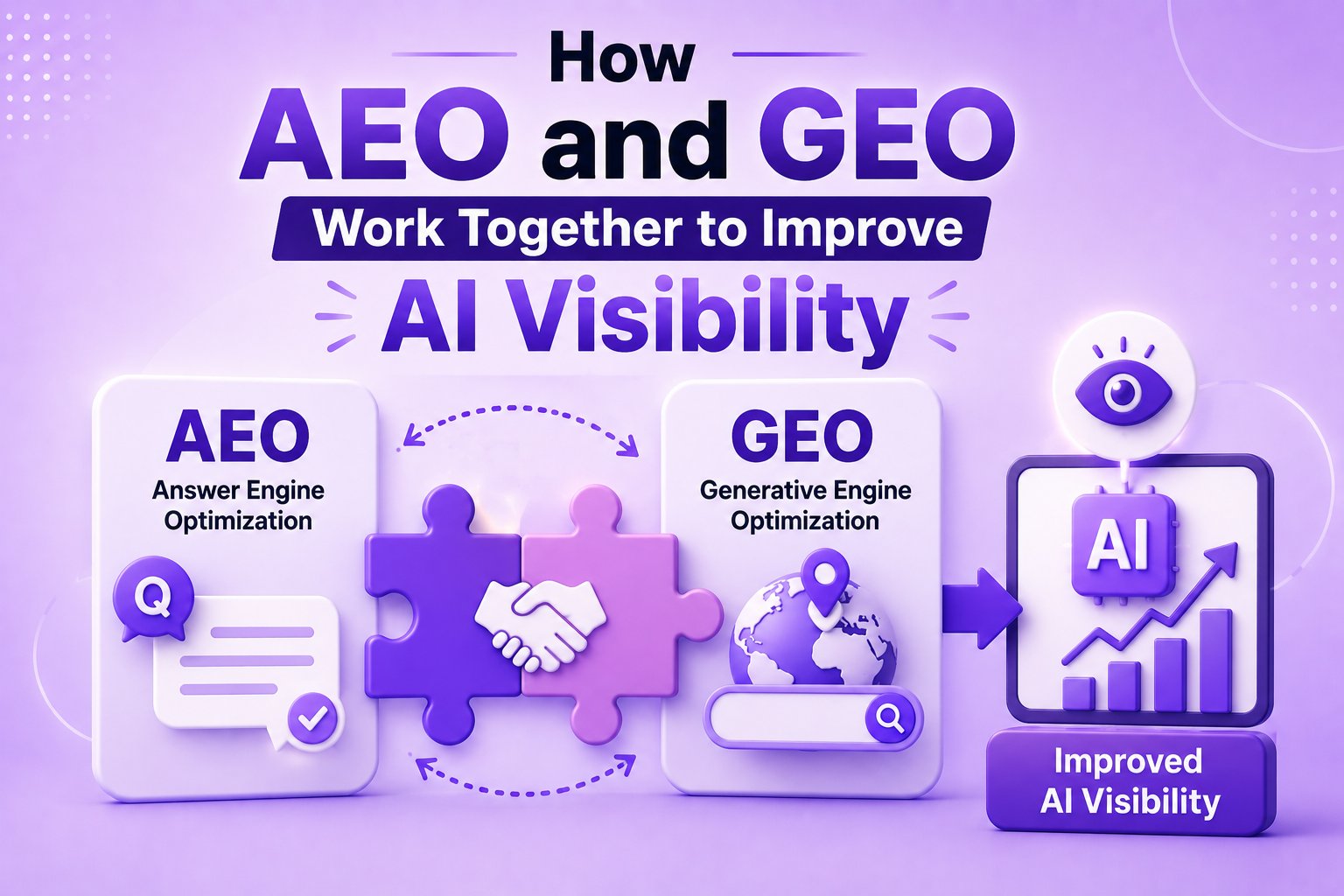
All of this has led to new marketing competencies that every marketer should know about. Answer Engine Optimization and Generative Engine Optimization are the two new, with the combination of the two being known as AI Visibility. This refers to how often AI’s will “see”, cite, and incorporate your content into their answers.
It is important to note that this is not just SEO for AI search. AEO and GEO solve different problems and should be used together to get content that is both discoverable and reputable and will be used by AI’s in their responses.
What is AEO and How Does it Work?
AEO or Answer Engine Optimization, is about content that AI’s use for answer snippet boxes. It is a matter of writing in such a way that when somebody asks a question that requires an answer, the AI will look at your content first and feature it.
In fact, this is like writing for a person who reads your page in ten seconds and demands answers. The very first thing that needs to appear in response to the question about what AEO is from Google must be a definition.
AEO is about the following:
- Direct Answers – Put answers to questions right at the top and in the first or second paragraph, as these are what AI’s will pick up on first in the answering process.
- Structure – Use questions as subheadings, as this is how AEO-optimized content will be easily found and understood by AI’s.
- Short Paragraphs – AI’s will not parse huge chunks of text, so get to the point and provide concise information that can be summarized in a sentence or two.
- Schema Markup – Use schema markup for your FAQ or HowTo pages to help AI’s parse and understand your information better.
What is GEO and Why is it Important?
GEO stands for Generative Engine Optimization and is a much larger process compared to AEO. This is because AEO is competing to become the chosen answer; in the case of GEO, it is making sure that your brand appears in the response generated by the AI on the basis of information drawn from different sources. An example is given below to clarify the difference between AEO and GEO.
If someone asks ChatGPT “What is the best CRM for small teams?” it is not going to simply lift your answer from a website and use it as its own. Instead, it will scan numerous articles and then provide a response of its own that will probably list 3-4 different CRM’s including yours.
As for how to go about doing GEO for AI Search, there are several things that one can do to get one’s brand out there. Here are some ways that one can improve GEO:
- Source Credibility – Write content with valuable and reliable information because AI’s will use you as a resource again and again.
- Original Data – Publish information that only you have because AI’s will want to cite you as a source of information.
- Entity Clarity – Use the same proper nouns (names, brands, etc.) consistently so that AI’s do not conflate sources and cite incorrectly.
- Cross Platform Presence – Appear on multiple platforms so that AI’s, in their quest for reliability, will keep coming back to you.
How Do AEO and GEO Work Together?
AEO and GEO are not competitors. They are simply two sides of the same coin. While the former allows one to get picked up in direct answers, the latter ensures that one is mentioned in generative answers.
In essence, AEO is about getting your brand in front of users in a very direct manner, whereas GEO is about building brand awareness across platforms so that when AI’s scan for information, they find you repeatedly. This leads to both direct and generative answers being enriched with your content.
Both are necessary because the way AI’s work is based on the type of search that one is doing. If one is doing a quick search for a fact, there is a very good chance that one will get a direct answer from AEO-optimized content.
However, for something longer and more involved, the same AI will provide a generative answer based on GEO-optimized content. If one focuses on only one area, one will miss out on the other. Thus, both AEO and GEO should be used together to improve AI Visibility.
AEO vs GEO for AI Search: What is the Real Difference?
Factor | Answer Engine Optimization | Generative Engine Optimization |
Primary Objective | Be selected as a direct answer | Be quoted as part of an extended answer |
Writing Style | Brief, clear, question-and-answer | Comprehensive, data-driven, in-depth |
Used Best For | Voice search, quick facts, snippets | Comparison pieces, reviews, research questions |
Primary Tools | Schema markup, FAQ format | Original research, brand consistency |
How you know it is working | Your answer appears in the snippet box | AI search tools cite/quote your brand |
How To Improve AI Visibility?
All of this together leads to the following steps on how to improve AI Visibility.
Step 1: Answer First
Answer the question directly first and then add further information after it.
Step 2: Structure Your Content
Ask questions as subheadings so that the content can be easily parsed by AI’s.
Step 3: Add Actual Data
Add information that is either unique to your website or difficult for AI’s to replicate.
Step 4: Develop Entity Signals
Use the same proper nouns consistently across your website and digital platforms.
Step 5: Keep Simple Code
Keep the code simple on your website so that AI’s can parse it correctly, using schema where necessary.
Step 6: Get Mentioned Somewhere
Ask others to mention you on their websites so that AI’s will recognize you as a credible source.
What To Focus on First: AEO or GEO?
This brings us to the next logical question. Now that one knows the differences between AEO and GEO, what should one focus on first? The answer to that depends on where one is starting from.
1. Start With AEO if: You have a strong-performing site that has content that is ready to be tweaked to be optimized for direct answers with schema.
2. Start With GEO if: You have lots of information that needs to be put together consistently across platforms.
3. Run Both Together if: You have the resources to do both; a page well optimized for AEO will have half of the work done for GEO.
4. Fix This First: Fix your basic SEO for AI search needs before you start doing either one of these, as pages need to load fast for AI’s to even pick them up.
Conclusion
Classical SEO for AI search engines is definitely not dead. In fact, it is the start on which everything else is built. AEO improves content so that it gets picked up as a direct answer right away, whereas GEO helps content be discovered by AI’s so that it can be cited as a source for generative answers.
Frequently Asked Questions
AI search gives one direct answer from multiple sources, whereas Google will give a list of links for one to follow.
Yes, you can start with simple SEO practices like having clear subheadings, direct answers, schema code, and unique content, though an agency like NextBigBox will help your ROI build up smoothly.
Google Search Console, schema checking tools, and answer trackers are some of the tools that can help.
No, SEO will always be the bedrock upon which everything else is built. AEO and GEO, by contrast, are about getting picked up by AI.
Type in your brand or the topic that you want to search for in ChatGPT or Perplexity and see if your content shows up.



Leave a Reply