
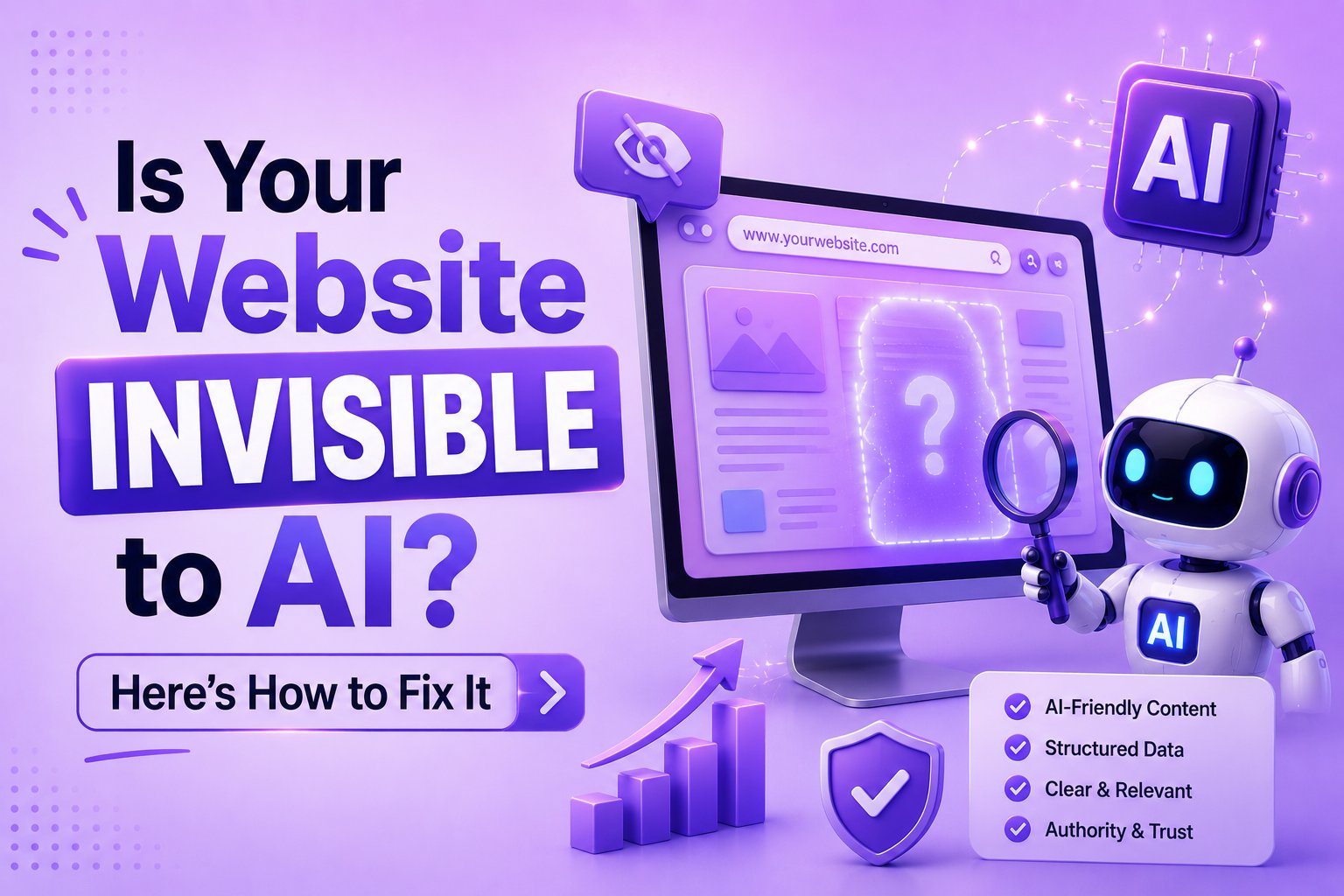
Just input a query into ChatGPT, Perplexity, or Google and receive answers directly from the sites that answered the question. If your site isn’t in it, however, then you need to change your tactics.
The majority of website owners are unaware of poor website visibility in AI search. To rectify this, it is important to understand what it is and what must be done to correct it.
How To Check if Your Site is Invisible to AI Search?
These are also what you need to correct first when you optimize a website for AI search. Most of them take less effort to fix than site owners assume. Follow these steps to check:
Step 1: Google search and ask about your product/services that your target customers would actually ask.
Step 2: Inquire with other AI tools about your product category, services and frequently asked queries about your product by your customers and take note of whether your website is referenced or not.
Step 3: Analyse if your website also gets recommended in your niche by these AI tools and compare which competitors have been seen more often than your brand in the answers.
Step 4: On key pages, include clear, unambiguous details regarding products, services, locations, pricing, features and answers to common customer questions.
Step 5: Document your search results, AI-generated responses, brand name mentions, and competitor mentions to determine visibility gaps and track progress over time.
Why Doesn't Ranking on Google Guarantee AI Visibility?
Traditional SEO enables you to be found by matching keywords to search queries. AI systems work differently. They read your page and divide it into its constituent parts. Then they choose to cite or summarize your content, or simply ignore it! Classic search results can be at the top of the page and not be included in an AI answer engine.
The key to Website Visibility in AI Search is not to repeat the keyword, but to make your content easily answerable. Google’s own documentation on AI features confirm that AI Overviews and AI Mode use the same index that powers regular search results. They then employ a method known as query fan-out to choose those answers that are clear and most directly relevant from that pool.
What Makes AI Systems Trust and Cite a Page?
This is the actual key to AI Search Optimization, and it’s synchronous with Google’s own quality raters framework.
1) It’s known as E-E-A-T. Experience, Expertise, Authoritativeness and Trustworthiness. The same signals are used for AI answer engines. They are properly educated to enjoy material that appears credible.
2) Be demonstrative of experience. Use data found or documented, not from regurgitating another person’s article.
3) Identify a real expert. Include the expert and a brief bio. The less well-known the author, the less credible.
4) Assert with reference to authoritative studies. This then allows AI systems to check your facts with other sources.
5) The publish date and an updated date are displayed. On the flip side, AI tools give greater weight to recently reviewed material on topics that change rapidly.
How To Optimize a Website for AI Search?
Here is how to optimize a website for AI search without changing everything at once. If you would rather have this managed for you, this work is also covered under a proper search engine optimization service, since most of these steps are already part of standard SEO practice.
Firstly, this one aspect of the list is the best at improving websites for AI search engines.
Using Article, FAQPage, and Organization schemas: Machines will correctly comprehend the content of your page. This requires minimal effort, but according to recent research findings, it is not foolproof for citation purposes.
The real name of the author: Mentioning a small biography with each of your articles will give you more credibility and accountability.
Using actual figures: Do not use general words; instead, use actual figures and/or research findings. They are easy to quote by using AI search engines.
Making subheadings: In order for models to understand a single idea, do not have long walls of text.
Optimize pages: Optimize images and eliminate any unnecessary scripts or do this at a proper website development build. Pages that take a long time to load are not read by either people or AI crawlers.
Create clusters on the topics: Organize related articles on one particular topic. AI loves to gather data from detailed sources rather than one page source.
Know your entities: This includes your company name, product lines, etc. This will allow AI to know what your business is all about.
Citation acquisition: Look for comparisons, roundup sites, and reviews. Backlinks continue to be the most important ranking factor as far as AI citation goes.
Conclusion
This will give you insights on how well your brand performs in the current search environment in both Google search as well as AI search. In the wake of the absence of your website not being featured often in AI responses, it is now time to optimize your website content clearly, answering customer queries and having consistency in your business information.
Frequently Asked Questions
AI Search Optimization refers to producing content that can be easily understood by AI-driven tools like ChatGPT and Perplexity.
SEO means optimizing your website so that it ranks well in Google search. In contrast, AI Search Optimization means getting your content referenced in AI answers.
There is no specific timeline. Maintain usefulness, accuracy, and frequent updates of your content to get visibility in AI searches.
No, it is not required for AI searches. But you can use schema markup in order to ensure that your content is easily understandable for search engines.
Of course! Useful content is the key to being visible in AI searches.



Comments (3)
Vishnusays:
August 27, 2026 at 5:46 pmplease my follow badhado
Jishan ansarisays:
August 30, 2026 at 1:24 pm😄😄😄😄
Jishan ansarisays:
August 30, 2026 at 1:27 pmUtter pradesh pilkhuwa