
Content marketing is everywhere but, unfortunately, not all content is good content. Articles get ignored by readers, videos don’t get seen, and email marketing goes straight to junk. All this because not everyone knows how to make their content work. To understand why some people manage to grow their businesses through content marketing stages while others continue guessing, it’s important to know about the different stages of content marketing.
Every piece must have its purpose, target audience, and move that person towards making a certain decision. Content created on the basis of the content lifecycle will be systematic and work for you even when you’re not active.
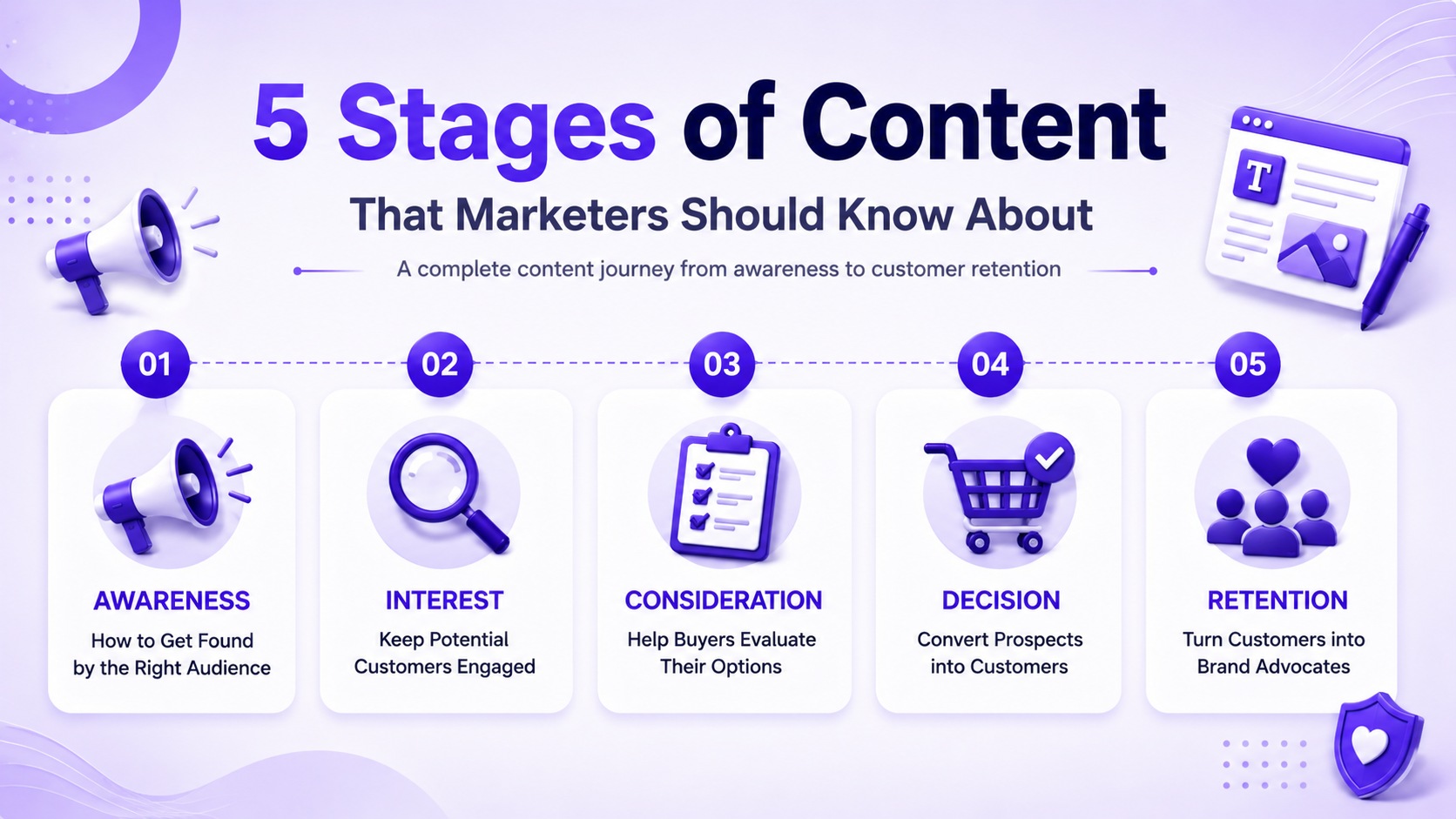
What are the 5 Content Marketing Stages?
All five stages are an accurate portrayal of the whole buying process undertaken by potential clients. They call for a unique piece of information, a different writing style, and a specific goal. If you fail to implement any of them, there will be holes in your content strategy funnel that result in lost leads and sales.
This is what each stage stands for:
- Awareness – Getting discovered by relevant people
- Interest – Retaining their attention once discovered
- Consideration – Enabling comparison and evaluation
- Decision – Transforming prospects into customers
- Retention – Making customers your advocates
How Each Content Marketing Stage Works
Each stage targets a different mindset and needs a different type of content to move people forward.
Stage 1: Awareness Stage: How to Get Found by the Right Audience
In order for your product or service to be purchased, first, they have to know that you are there. It may seem like common sense, but most companies overlook this step because it doesn’t yield an instant conversion. This is a big blunder.
This kind of content makes up the TOFU aspect of TOFU MOFU BOFU content model. In this phase, consumers don’t know about your brand; they may not even know that there is a problem yet.
What content works at this stage:
- Educational blog posts
- Short-form videos
- Social media content
- Podcasts
- Infographics
The tone is informational. The goal isn’t to sell. It’s to be genuinely useful and earn attention. If your awareness content leads with a pitch, you’ve already lost them.
Stage 2: Interest Stage: How to Keep Potential Customers Engaged.
Once they discover you, the second question on their minds is, “Why should I care?” It is at this point that most businesses lose people simply because of how hard they try to sell the point or because the information they provide is completely useless.
Content at the interest stage develops the relationship. Your purpose here is to show that you actually know more about their problems than they do themselves.
What types of content work best at this stage:
- How-to articles
- Comparative articles
- Newsletters
- Webinars
- Case studies
This is also when your content strategy funnel comes into action. They are actively searching, and your content is either helping them move forward or sending them to your competitors.
Stage 3: Consideration Stage: What Content Helps Buyers Evaluate Their Options
By this point, the reader knows what their problem is. They’re researching solutions and comparing options. They could already be checking out your competitors.
This is the MOFU (middle of funnel) layer in the TOFU MOFU BOFU content framework. Your content here needs to be more specific and more honest.
What content works at this stage:
- Detailed product guides
- Comparison posts
- Customer testimonials
- Demo videos
- ROI calculators
Buyers at this stage are skeptical. They’ve read the marketing copy. What they want is proof and clear answers to the doubts already in their heads. Address those doubts directly.
Stage 4: Decision Stage: Content That Converts Prospects Into Customers
The prospect is ready to make the purchase, or is almost there. All that’s left to do is ask one final question or address one final doubt.
The bottom of the funnel (BOFU) stage of the content marketing stages framework is where this happens, and this is when precision becomes key.
Content types that work in this stage:
- Free trials
- Product demos
- Pricing pages
- Testimonials from satisfied customers
- Limited-time offers
A common mistake by marketers at this stage is assuming all BOFU content fits one mold. The person who has spent three months following your newsletters requires a different approach than the one who has clicked through from your Google Ad to land on your pricing page.
Stage 5: Retention Stage: How to Turn Customers Into Long-Term Brand Advocates.
Securing the deal is one thing. Retaining the client, converting them into a repeat client, and even having them refer more clients, that’s where the real value lies.
This isn’t the end for the content lifecycle stages, and neither should it be an end for your content strategy.
Types of content useful at this point:
- Onboarding emails
- Product tutorials
- Community content
- Loyalty programs
- Re-engagement campaigns
Retention content is integrated right from the start with NextBigBox. Satisfied clients don’t just stay, they bring along new business too.
Quick Reference: All 5 Content Marketing Stages at a Glance
Stage | Funnel Position | Content Type | Primary Goal |
Awareness | Top of Funnel (TOFU) | Blog posts, videos, social content | Build visibility and reach |
Interest | Top-Mid Funnel | Newsletters, guides, webinars | Earn attention and trust |
Consideration | Middle of Funnel (MOFU) | Comparisons, case studies, demos | Help them evaluate options |
Decision | Bottom of Funnel (BOFU) | Trials, testimonials, pricing pages | Convert prospects into customers |
Retention | Post-Purchase | Onboarding, tutorials, loyalty content | Drive repeat business and referrals |
Conclusion
Knowing about the stages of content lifecycles can never be an option for marketers who wish to achieve consistency in their marketing efforts. All content needs a stage, a purpose, and an obvious direction after that. In short, when the content is aligned and functions like a system and not a random set of blog posts, then it all works out.
Frequently Asked Questions
The five stages are Awareness, Interest, Consideration, Decision, and Retention. Each one targets a different point in the buyer's journey and requires a different type of content.
It gives your content a clear structure. TOFU builds awareness, MOFU nurtures consideration, and BOFU drives conversions. Together they cover the full content strategy funnel.
They help you create the right content for the right audience at the right time. Without them, your content has no direction and your results stay inconsistent.
List your content, identify what goal each piece serves, and match it to the five content marketing stages. Where you find gaps, that's where you create next.
NextBigBox helps businesses plan content that covers every stage of the buyer journey, making sure each piece has a clear purpose and drives real results.


Leave a Reply