
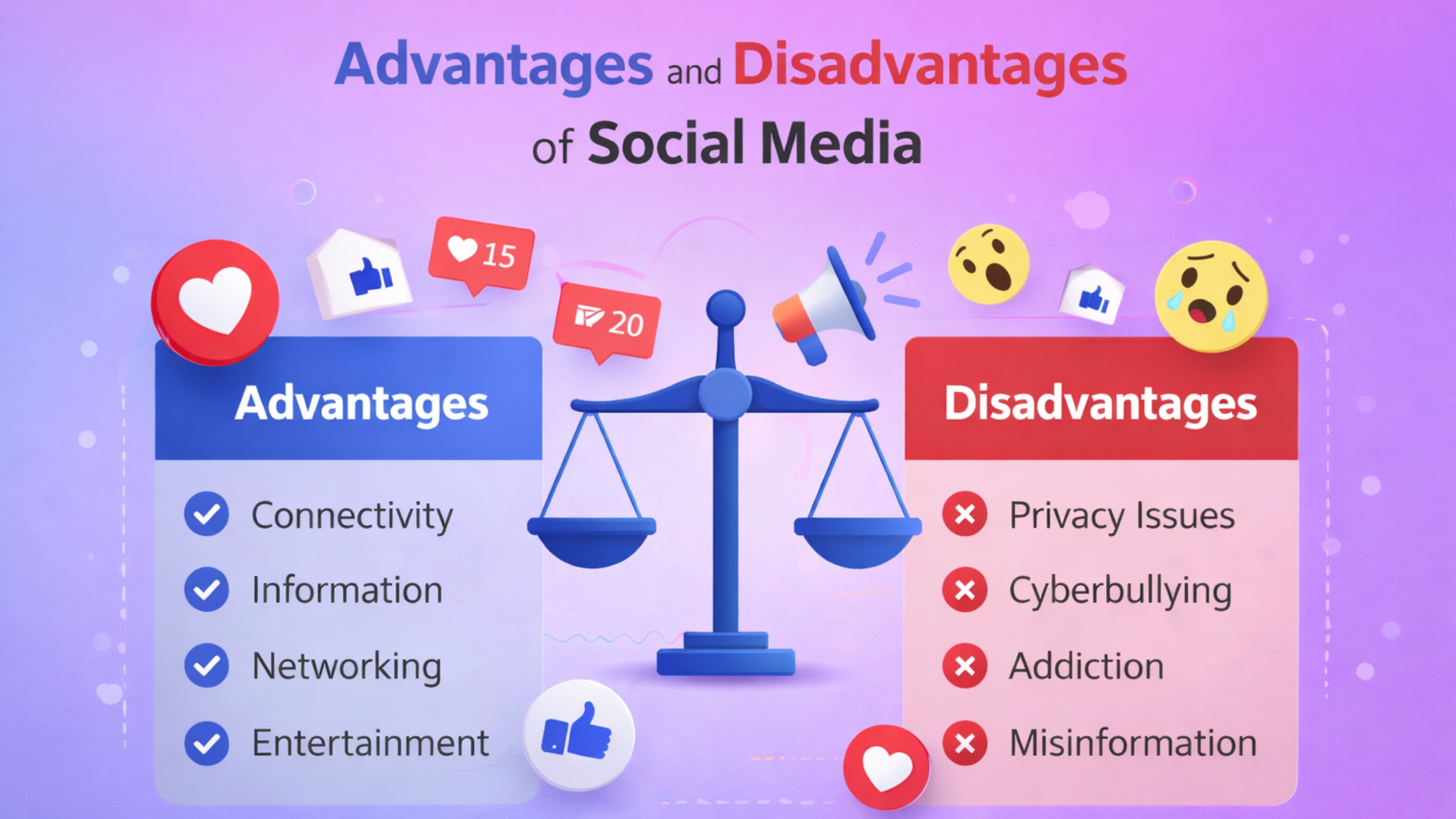
When the entire world is connected through the internet, and there are multiple platforms for establishing connections for communication, spreading information related to business, etc., understanding the advantages and disadvantages of social media has become essential for individuals and businesses of all sizes. Whether you are a startup trying to build brand awareness or an established company willing to maintain customer loyalty, social platforms can play a major role in shaping your growth.
The advantages of social media are enormous, but at the same time, they come with certain challenges, and businesses must carefully understand all the factors, especially what to do and what not to do. Let’s understand the advantages and disadvantages of social media in depth.
The Significance of Social Media
Social media is not just a communication tool; it has become a powerful business ecosystem. All the prominent platforms like Instagram, Facebook, LinkedIn, and YouTube have transformed how businesses connect with customers, promote products, and build brand identity.
So, with multiple updates from digital marketing campaigns to customer service interactions, social media has become an integral part of business strategies across industries.
Advantages of Social Media for Businesses
1. Cost-Effective Marketing
It can be considered as one of the biggest advantages of social media, which is affordability. Compared to traditional advertising methods, especially TV or print, social media marketing allows businesses to reach a large audience with a minimal investment.
Startups and particular businesses can get the benefit from this as they can run targeted ads and organic campaigns without investing a heavy budget.
2. Increased Brand Awareness
Social media platforms are helping businesses to reach global audiences instantly. You can do it with consistent ad posting, creative content, and engagement that can help your brand stay visible and relevant.
With such a strategy, now, even small businesses can compete with larger brands by building a strong online presence and connecting directly with their audience. And all these are possible through social media only.
3. Direct Customer Engagement
Using social media, businesses can interact with customers in real time through comments, messages, and live sessions. And, this direct communication builds trust and strengthens relationships.
It also allows companies to receive instant feedback that can help in improving products and services quickly.
4. Targeted Advertising and Analytics
With advanced algorithms, social media allows businesses to target specific demographics based on age, location, interests, and behaviour.
With detailed analytics tools, it can help in tracking campaign performance by giving businesses insights into what works and what doesn’t. It helps in making marketing strategies more effective.
5. Boost in Sales and Lead Generation
Social media platforms with integrated shopping features can help businesses sell directly through apps. This reduces the multiple gaps between discovery and purchase.
For startups and small businesses, it can help in lead generation and improved conversion rates.
6. Competitive Advantage
Businesses using social media can stay ahead of competitors. They can adapt to trends quickly, launch new products, and engage with audiences more effectively.
Disadvantages of Social Media for Businesses
While considering all these significant benefits, the disadvantages of social media must be considered together so that you can maintain a balanced strategy.
1. Time-Consuming Management
While managing multiple social media accounts, it can require consistent effort, creativity, and monitoring, small businesses with limited resources may find it challenging, especially in maintaining regular posting and engagement. However, it can be solved by consulting an expert and reliable digital marketing agency.
2. Negative Feedback and Public Criticism
Social media is a public platform where customers can openly share their opinions. In such cases, any negative reviews or complaints can hamper the reputation. And therefore, maintaining a good reputation might be challenging.
3. Algorithm Dependency
Social media platforms frequently update their algorithms that can affect the content visibility. And therefore, in multiple cases, the post that performs well today may not reach the same audience tomorrow. It is considered a disadvantage. However, it can be solved via audit and adaptability.
4. Data Privacy Concerns
With increasing concerns about data security, businesses must be cautious about the collection and use of customer information.
5. High Competition
Millions of businesses are active on social media, and it is making it harder to stand out. Therefore, creating unique and engaging content consistently can be a challenge.
Impact of social media on Small Businesses
For small businesses, the advantages of social media often outweigh the challenges. It provides a level playing field where even a small brand can achieve visibility and growth.
However, small businesses must focus on all these factors while using social media for brand awareness, and these are as follows.
- Choosing the right platform: You must select the right platform depending on your brand.
- Creating consistent content: since consistency is the key in digital marketing, you must have consistency.
- Engaging actively with their audience: while using social media, posting engaging content is always essential.
So, with all these, i.e., with a well-planned strategy, you can turn social media into a powerful growth tool.
Impact of social media on Startups
It has often been seen that startups rely heavily on social media to build brand awareness and attract early customers.
And some key benefits include:-
- Low-cost marketing
- Rapid audience growth
- Direct feedback for product improvement
However, startups must also be careful about brand positioning and avoid inconsistent messaging, which can confuse their audience.
Impact on Established Businesses
Established companies use social media differently, and while doing so they can focus on:-
- Maintaining brand reputation with consistent posts.
- Engaging with loyal customers to maintain reputation
- Launching new campaigns and products
For them, one of the biggest challenges is managing customer interactions and maintaining a consistent brand voice across platforms.
How Businesses Can Maximise Benefits
To effectively ensure the advantages of social media marketing, businesses must adopt the following strategic approach and these are as follows.
- Create Quality Content: You must focus on value-driven and engaging posts
- Use Analytics: Always track the performance and strategies.
- Stay Consistent with Regular posting that can build trust and visibility
- Engage actively with and respond to comments and messages promptly
- Manage Reputation by Addressing negative feedback professionally
Future Trends in Social Media
Social media can continue to evolve with new trends like:
- AI-driven content recommendations for fast and consistent performance.
- Short-form video dominance
- Social commerce expansion
- Influencer marketing growth
Businesses that adapt to these trends can perform well with a competitive edge in the digital landscape.
Conclusion
Understanding the advantages and disadvantages of social media is crucial for businesses aiming to succeed, especially with the trends and strategies. Some advantages of social media, such as cost-effective marketing, global reach, and direct engagement, can offer immense opportunities, but the challenges, like competition, algorithm changes, and reputation management, cannot be ignored. To ensure all these benefits for social media, adopt a specific strategy to enhance the revenue for your business.
Frequently Asked Questions
Social media offers cost-effective marketing, increased brand awareness, direct customer engagement, targeted advertising, and improved sales opportunities, making it a powerful tool for business growth.
Some major challenges include time-consuming management, negative public feedback, dependency on algorithms, data privacy concerns, and high competition among brands.
Social media provides a low-cost platform for marketing, helps in building brand awareness, enables direct customer interaction, and supports rapid audience growth, especially for startups and small businesses.
Established businesses use social media to maintain brand reputation, engage with loyal customers, launch new products, and stay competitive in the digital market.
Businesses can maximise benefits by creating quality content, staying consistent, using analytics to track performance, engaging actively with their audience, and managing their online reputation effectively.






Leave a Reply