
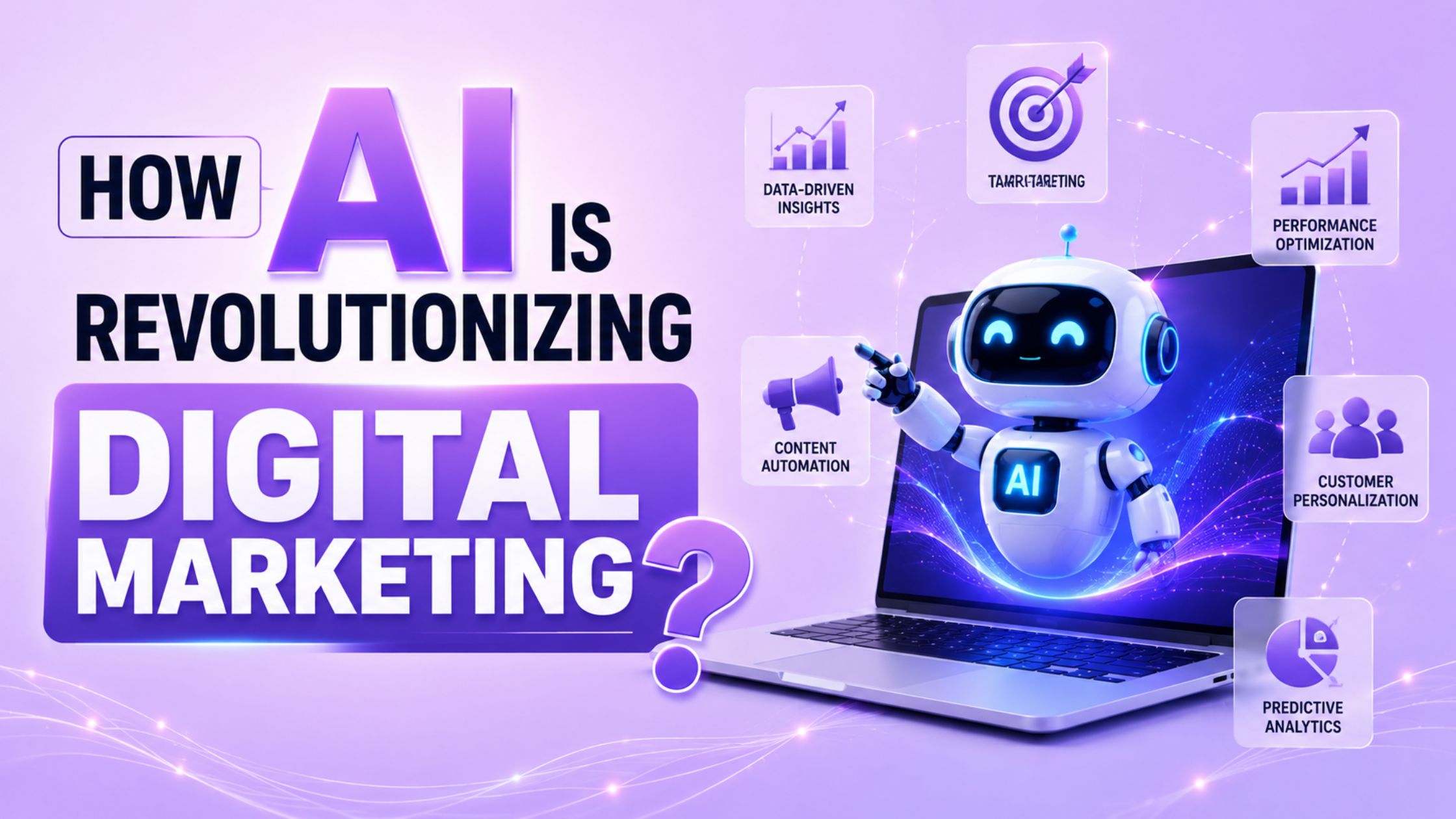
Marketing was once based on a method of trial and error. You’ve chosen an audience, written an ad, launched it, and waited to see if it worked for weeks. Then worked on correcting if something had gone wrong. There’s no longer that world. AI in digital marketing has taken the place of lengthy guesswork with rapid, data-driven decisions, and the shift occurred sooner than many anticipated.
This is not meant to be about bots writing your posts or bots commenting on every comment on your post. It’s about the automation of the effective things, repetitive aspects of marketing, leaving room for creative thinking and ideas.
What is AI in Digital Marketing?
It is the use of intelligent software to analyze customer behavior and draw marketing conclusions in less time than a human team. Artificial Intelligence marketing focuses on analyzing user behavior, click patterns, purchases, and searches to predict the next item they might want to click on, buy, or search for.
You already know how to do this, without thinking about it. This is what happens when Netflix recommends a movie or Amazon recommends a product you didn’t look for.
What are the Benefits of AI in Digital Marketing?
Any business aims for three things: increased attention, increased sales and reduced wastage of money. Let’s take some example companies that were early adopters of these tools:
- Speed – Decisions were made in weeks before, now in hours, even minutes.
- Accuracy – Ads are placed with the right audience, not anyone who may be interested.
- Scale – One employee is now able to handle a thousand or thousands of customers at a time.
- Saving – Not spending ad dollars on ineffective ads.
Real Examples of AI in Marketing You Use Daily
Small businesses can now use the same tricks that big brands like Spotify and Amazon built their entire model around.
1. How AI Personalizes Your Shopping Experience
Software tracks past clicks, searches, and purchases and presents products and offers that closely match what you’ve already demonstrated an interest in.
2. How AI Chatbots Improve Customer Support
Chatbots respond to customer inquiries right away, on a 24×7 basis, and process common, repetitive questions, thus freeing up time for real personnel to work on more complex, individual issues.
3. How AI Predicts Customer Behavior
A software application that analyses consumer behaviour patterns to identify which customers are likely to buy and which may be on the verge of buying.
4. Best AI Marketing Tools for Content Writing
Tools handle keyword research, headline testing, and content gap analysis within minutes, work that used to take writers several hours to complete manually.
5. How AI Automates Digital Ad Buying
As soon as software offers to bid on available ad inventory, budgets move accordingly from non-performing ads to highly effective ones and drive the right ad to the right person at the right time.
Old Way vs New Way: A Quick Look
Marketing Task | Old Approach | New Approach |
Finding your audience | Broad guesses based on age or location | Targeting based on actual behavior |
Spending ad money | Manual budget changes | Automatic shifts to what’s working |
Answering customers | Only during business hours | Instant replies, any time of day |
Researching content | Hours of manual keyword hunting | Quick, automated topic and gap finding |
Checking results | Weekly or monthly reports | Live updates you can check anytime |
Will AI Replace Marketing Jobs?
This is the question that most people would like answered. It’s not doing everything; it’s doing the dull work! AI marketing tools help with data sorting, conducting simple tests, and tweaking ad bids are tasks that machines perform effectively. Further, it’s still people who bring judgment, empathy and original ideas. Some real changes are occurring now:
- New skills – Marketers today must not only be able to design and write, but they also need to be able to understand data and tools as well.
- Smaller teams – work that used to require a much larger team can now be done by smaller teams.
- Faster fixes – Campaigns are adjusted during the campaign instead of at the end.
- More creativity – More time goes toward big ideas since routine number checking runs on its own.
Top AI Marketing Trends to Watch in 2026
Looking ahead, the future of AI in marketing lies in the integration of even more human-like tools in the creative process.
1. Predictive customer needs, personalized video ads, and voice search are becoming commonplace.
2. There will be more importance on trust as well. People want to know when they are communicating with a bot and not a human, and guidelines on sharing personal information are becoming more and more robust.
3. Any brand that admits to using these tools will gain more loyalty than those who are trying to conceal them.
4. Search behaviours are also changing. Talking and uploading a photo to search are gaining popularity. Marketing plans that rely solely on keywords typed will have to be modified.
How to Start Using AI in Your Marketing Strategy
Here are 5 steps that you need to follow:
Step 1: Spot the problem
Choose one problem at a time, rather than attempting to address multiple issues simultaneously, such as poor customer response or ineffective ads.
Step 2: Identify one tool to use
Don’t use a large “all-in-one” tool to solve every problem; use one that was created specifically for this problem.
Step 3: Determine a trial period
Test it for a month or so and then allow the data to be collected in reality before deciding whether it’s really doing anything.
Stage 4: Measure real numbers
Monitor clear statistics, such as response time, conversion rate, or cost per customer, before and after, not on instinct.
Step 5: Expand gradually
The first time a tool comes in handy, try using a second for another issue and gradually build your system over a period of time rather than fixing it all at once.
Conclusion
Artificial intelligence marketing hasn’t replaced good marketing instincts, it has sharpened them. Businesses doing this well pair human creativity with machine speed, letting each one do what it does best. That mix is quickly becoming normal, and the marketers who learn to work alongside it, instead of against it, are the ones seeing real results.
Frequently Asked Questions
No. It removes repetitive work like reporting and ad bidding, but strategy and creativity still need a real person.
Pick one problem, like slow replies or weak email performance, and try one tool built to fix that specific issue.
Many affordable and even free options exist, especially for email, chatbots, and basic keyword research.
Not when it's done right. Good personalization actually makes people feel more understood, not less.
Track clear numbers like sales, response time, and cost per customer before and after you start using it.


Leave a Reply