
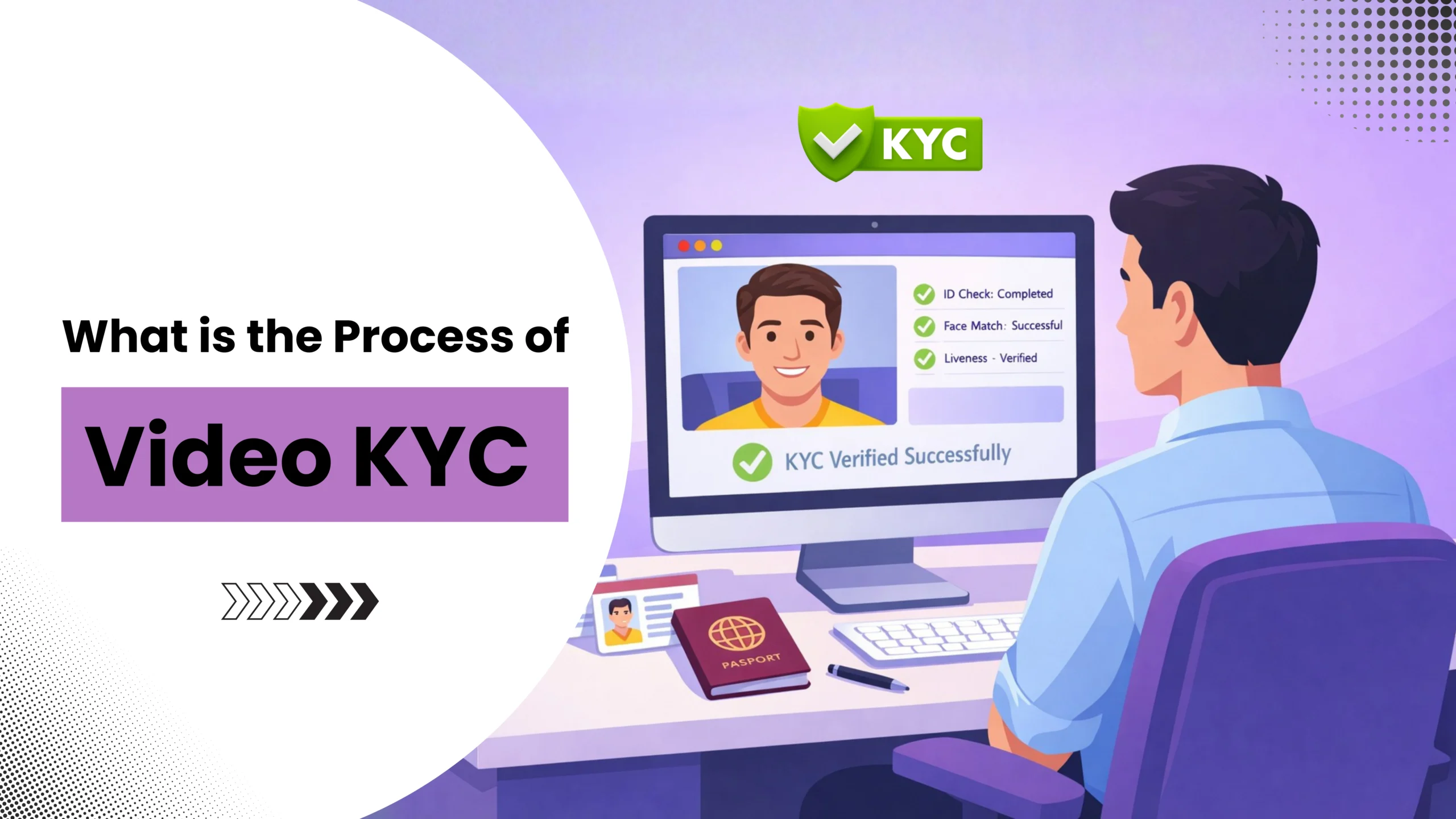
The term video KYC might sound familiar to you until you check for it and then you get a little bit confused and you doubt whether that is the video stored. And how does the company know that the person in the ID is actually you? Most of the people never get clear answers and that is why they hesitate to apply. That is why understanding the Video KYC process is essential so that you can trust the outcome.
In this blog, you will understand the process of video KYC. You’ll learn how it works, from showing your ID to completing the verification, and why each step is important. By the time you finish reading, the whole process will make sense, whether you’re a customer or a business looking to use it.
What is Video KYC?
Video KYC is a way of verifying the identity of a person through a video call or a recorded video rather than requiring the person to physically come to a bank or office. This video KYC process ensures that the person is genuine and that the ID is authentic.
For instance, assume that your business is acquiring a new online client. Rather than requiring them to physically come to your office, you will provide them with a link to a video call. The client will display their ID card to the camera, and the system will verify that the face in front of the camera matches the one in the ID card photo. The system will also ensure that it is a person in front of the camera and not just a photo or video.
This process is fast and secure. This will ensure that your business is able to confirm the identities of your clients effectively without having to come to your office in person, while at the same time ensuring that all the sensitive information is secure. This process ensures that the process of onboarding your clients is smooth and trustworthy.
What is Video KYC Process?
Here is how a typical verification session works. At NextBigBox, we provide this service to help businesses onboard clients quickly, securely, and without requiring in-person visits.
Step 1. User onboarding and consent
The user is required to give basic information and consent to video recording and use of the data at the first stage. This permission is documented and kept in case of compliance.
Step 2. Identity document capture
The user enters a valid ID card. The system scans through the images or a video scan and authenticates the image through the OCR and document security features.
Step 3. Live Verification
The user must get on camera to verify his/her face, which matches the ID photo. Liveness detection properties, head movement and blink commands prove the availability of a live user and not merely a photo or video spoofing.
Step 4. Human-monitored automated checks
The computerized system checks the validity of the documents, the biometric scores and the information about the session. In case any irregularities are detected, then the case is taken to a human evaluator to be evaluated manually.
Step 5. Documenting and safe storage
This is all logged and stored together with the associated metadata of the timestamps and verification outcomes. This assists in the creation of an audit trail.
Step 6. Approval decision
The system will show you these:
- Done – It means that your ID is verified.
- Try Again – This means that something did not work and you need to try again.
Every single action of the Video KYC procedure shall be aimed at creating a balanced approach in terms of speed, accuracy, and regulatory feasibility.
Difference Between Video KYC and Traditional KYC
Video KYC is faster, safer, and more convenient than traditional KYC, which requires in-person verification and more time.
|
Feature |
Video KYC |
Traditional KYC |
|
Time |
Minutes |
Days or weeks |
|
Location |
Anywhere with internet |
Must visit the branch/office |
|
Cost |
Very Low |
Higher due to staff and travel |
|
Fraud Risk |
Very Low (live video & face match) |
Medium/High |
|
User Convenience |
High (no travel, quick process) |
Low (travel, waiting lines) |
|
Compliance Proof |
Automatic video recording |
Manual record keeping |
|
Scalability |
Easy for many clients |
Harder to scale |
Video KYC Security, Privacy, and Regulatory Compliance
When using Video KYC for identity verification, protecting your personal information is crucial. Both businesses and users want a process that is secure, private, and legally compliant.
How Video KYC Keeps Your Data Safe
- Encrypted Data: All your information, documents, videos, and personal details is securely encrypted during storage and transmission.
- Access Control: Only authorized personnel can access verification data, ensuring privacy.
- Data Retention Policies: Companies follow strict rules on how long data is stored and when it is deleted.
- Audit Logs: Every verification step is recorded, creating a clear and transparent audit trail.
Regulatory Compliance in Video KYC
Regulators such as RBI, SEBI, and other authorities require businesses to maintain proof of identity verification. A compliant Video KYC system ensures:
- Identity verification is accurate and complete
- The verification date and time are recorded
- The process follows all legal guidelines
A well-documented Video KYC system helps businesses pass audits and inspections while giving users confidence that their sensitive information is protected.
Why This Matters for Users
- Users can trust that their personal data is safe.
- Online verification is legally valid and widely accepted.
- Businesses can provide fast, secure onboarding without compromising privacy.
Benefits of Using Video KYC in 2026
By 2026, digital onboarding is no longer optional. Customers expect speed, regulators expect proof, and businesses need systems that can scale without adding friction.
1. Faster onboarding – Clients can verify themselves remotely, reducing onboarding from days to minutes and minimizing drop-offs.
2. Lower fraud risk – Live video, facial matching, and liveness detection make it more difficult to impersonate a client compared to document verification.
3. Easier compliance – Recorded sessions and consent records provide a clear audit trail for compliance purposes.
4. Better client experience – No travel, no lines, no branch visits required. Clients simply go through a guided verification process from anywhere.
5. Cost-effective at scale – More clients can be onboarded without adding staff or operational expenses.
Conclusion
Video KYC identity verification is a trustworthy alternative to physical KYC if done properly. To understand the Video KYC process, businesses can select solutions that focus on compliance, security, and ease of understanding. NextBigBox can assist organizations in implementing an efficient Video KYC solution that is trustworthy and scalable.
Frequently Asked Questions
Yes, it is considered safe because it combines live video, face matching, and liveness checks to confirm that a real person is present. Sessions are recorded and stored securely, which helps prevent fraud and supports audits.
Not always. Some verifications are fully automated, while others include a short interaction with a trained agent, depending on regulatory needs and risk level.
In most cases, it is completed within a few minutes. It may take longer if the document is unclear or if the session needs manual review.
Clients are usually allowed to retry the process. If verification still fails, the case is reviewed manually or an alternative method is provided.
For many standard onboarding cases, yes. Some high-risk situations may still require additional checks based on local regulations.





Leave a Reply