
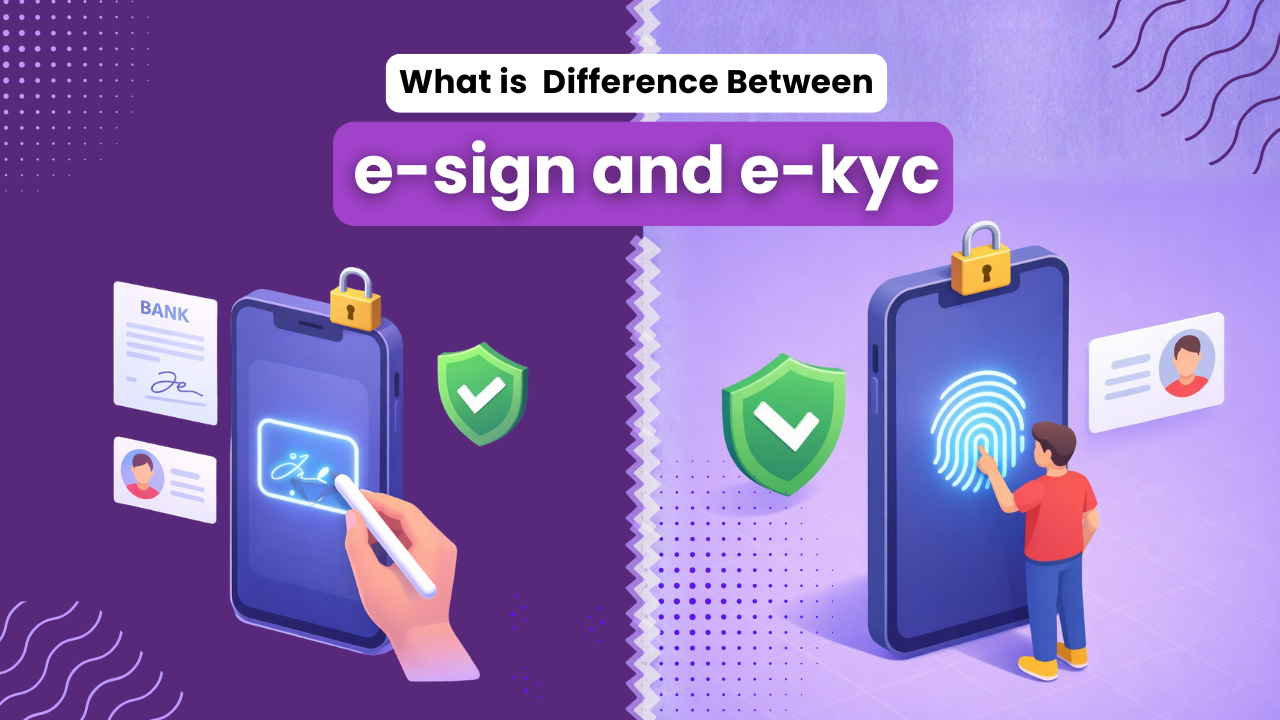
In the digital age, almost all services have been streamlined to a digital mechanism. And E-KYC, i.e., electronic know your customer, is the leading technique that helps organisations like banks, NBFCs, and other financial institutions enhance security by minimising efforts during customer verification. E-KYC helps the organisation verify and authenticate the customer identity through Aadhaar and PAN. Similarly, e-sign is also used for getting digital signatures with online services, and it reduces the paperwork, ink, and additional time required for these. Both services are authorised by the Unique Identification Authority of India (UIDAI), which is operated under the Ministry of Electronics and Information Technology. There are differences between e-sign and e-kyc, especially based on the services, features, benefits, and working processes. Some specific beneficial features are as follows.
What is E-KYC, and what are its beneficial features?
E-KYC is a digital process which is done with the Aadhaar-Based Verification and is available with multiple beneficial features like instant authentication and many more. With the complete digital process and under the regulation of the Unique Identification Authority of India (UIDAI), it has been enhancing the data security of organisations like banking, NBFCs, and other financial institutions. It comes with enormous features and helps you ensure multiple benefits. If you are dealing in finance, lending services, and still thinking of associating E-KYC services with your business, you can select any trusted IT company like Nextbigbox, which is facilitating a precise, e- sign and e-kyc at an affordable cost.
Features of e-KYC
1. Aadhaar-Based Verification
To make the verification simple, it uses Aadhaar authentication through the Unique Identification Authority of India. It helps in verifying customer identity with ease.
2. Paperless Process
With the complete paperless process, there is no need for physical document submission like Aadhaar and PAN. The complete process is digital.
3. Instant Authentication
The Verification process is done in real-time within seconds, especially using OTP or biometric authentication. It makes the process fast.
4. Secure & Encrypted
With the digital verification process, the customer data is encrypted and shared securely. It helps in reducing all types of risk of fraud or misuse.
5. Online & Remote Access
It can be completed anytime and from anywhere through your mobile or desktop. There is no need to visit the branch.
6. Auto-Filled Details
With OCR, the customer’s personal information, especially name, DOB, and address are captured automatically, and it reduces the manual entry errors.
Benefits of using e-KYC
It comes with enormous benefits like faster approval, reduced fraud chances, improved accuracy, and many more. Some essential benefits are
1. Faster Approvals
With fast identity verification, it enhances the speed of identification services, especially for NBFCs, banks, telecom and other organisations
2. Hassle-Free Experience
There is no paperwork and no need to submit physical documents. It saves the precious time of service providers and the company as well.
3. Cost-Effective
It saves the funds required for printing, storage and processing costs for both customers and financial institutions.
4. Reduces Fraud
With the Real-time Aadhaar authentication, it reduces the chances of fraud and minimises the chances of fake identities.
Go Through This Blog – What is Video KYC Process
How e-KYC Works
The E-KYC process is simple and fast, which reduces the time, usage of physical documents and many more:
1. Enter the Aadhaar number
2. Receive OTP on your registered mobile number
3. Authenticate using OTP or biometric
4. Your details (name, address, DOB, photo) are fetched automatically
5. Verification is completed instantly
What is E-Sign, its features and benefits
An e-signature is a digital process which uses digital signatures as an alternative to physical signatures. It saves time and other physical stuff used for the digital signature. There are slight differences between e-sign and e-kyc where e-sign is used for getting the authentication or digital signature, whereas e-kyc services is used for customer identification and verification.
Key Features of e-Sign
Some essential features of e-sign are paperless processing, fast services, real-time authentication and many more. Let’s understand the features.
1. Paperless Signing
There is no need for printing, scanning, or physical signatures. It is completely digital.
2. Aadhaar-Based Authentication
Like e-kyc, it is also available with Aadhaar-Based Authentication, especially through OTP or biometric linked to Aadhaar.
3. Instant Digital Signature
With e-sign, documents can be signed in real-time using a mobile or a desktop.
4. Legal Validity
e-Signatures are legally recognised and authentic as per the Indian IT laws, and it is accepted by banks and financial institutions.
5. Cost-effective
The e-signature helps you save costs as there is no need for the physical document verification.
Organisations that require E-KYC and E-Sign
E-KYC and E-Sign can be required for all these organizations like Banking and NBFCs, telecom, government and public sectors, corporate and HR, e-commerce and many more. Depending on the services, these digital processes can be used, such as.
- Banking & NBFCs: In banking, it can be used in account opening, lending services, implementing e-mandates (e-NACH), and KYC updates.
- Telecom: For telecom, while facilitating new connections, e-kyc is used for user verification.
- Insurance: In insurance services, it can be used for policy issuance, settlements, and changing of beneficiaries.
- Government & Public Sector: For document signing, applying for a passport, and for the issuance of different certificates, it can be used.
- Corporate & HR: While going through the Employee onboarding, providing offer letters, or other policy agreements, it can be used.
- E-commerce: For delivering services, generating invoices, and onboarding customers or third parties, you can choose the E-kyc services.
Conclusion
If you are planning to hire a trusted IT company for getting E-sign and E-Kyc, especially for implementing all the required services, you can choose the reputed IT company by checking its reviews, rating and credibility. As per the above mentioned discussion, the difference between e-sign and e-kyc can be clear. So, depending on the services, you can choose customized E-kyc processes with all the beneficial features.
Frequently Asked Questions
E-KYC is always used for customer identification and verification using Aadhaar and PAN details. Whereas the e-signature is used to digitally sign documents online.
E-KYC verifies the identity of the customer or client through Aadhaar authentication. Users enter their Aadhaar number, receive an OTP or use biometric verification.
Yes, e-signatures are legally valid in India and under Indian IT laws and are accepted by banks, NBFCs, telecom, and government departments.
Both services help in getting faster approvals, paperless processing, reduced fraud, lower operational costs, secure, encrypted data handling, and remote access.
It is generally used by the Banks, NBFCs, telecom companies, insurance providers, government departments, HR teams, and e-commerce platforms, etc.



Leave a Reply