
Nowadays, in the digital world, which is dominated by online and digital applications in almost all fields like finance, education, marketing and all. In such a situation, paperwork is mostly replaced by online documentation. Whether it is opening a bank account, signing a loan agreement, or signing any business contract, the eSign services are taking places which are authentic and approved. And, in all these cases, eSign Services are playing an essential role by reducing paperwork, the use of physical documents and additional efforts. Whether individuals or at an organisational level, electronically signed documents are considered secure, quick, and legally valid.
With enormous features, in India also, eSign has become significant and popular because of the growth of digital platforms and government-backed initiatives. But there are still multiple questions, especially related to the Process of eSign, its legal validity, and its types. Let’s discuss all these in brief.
What is eSign?
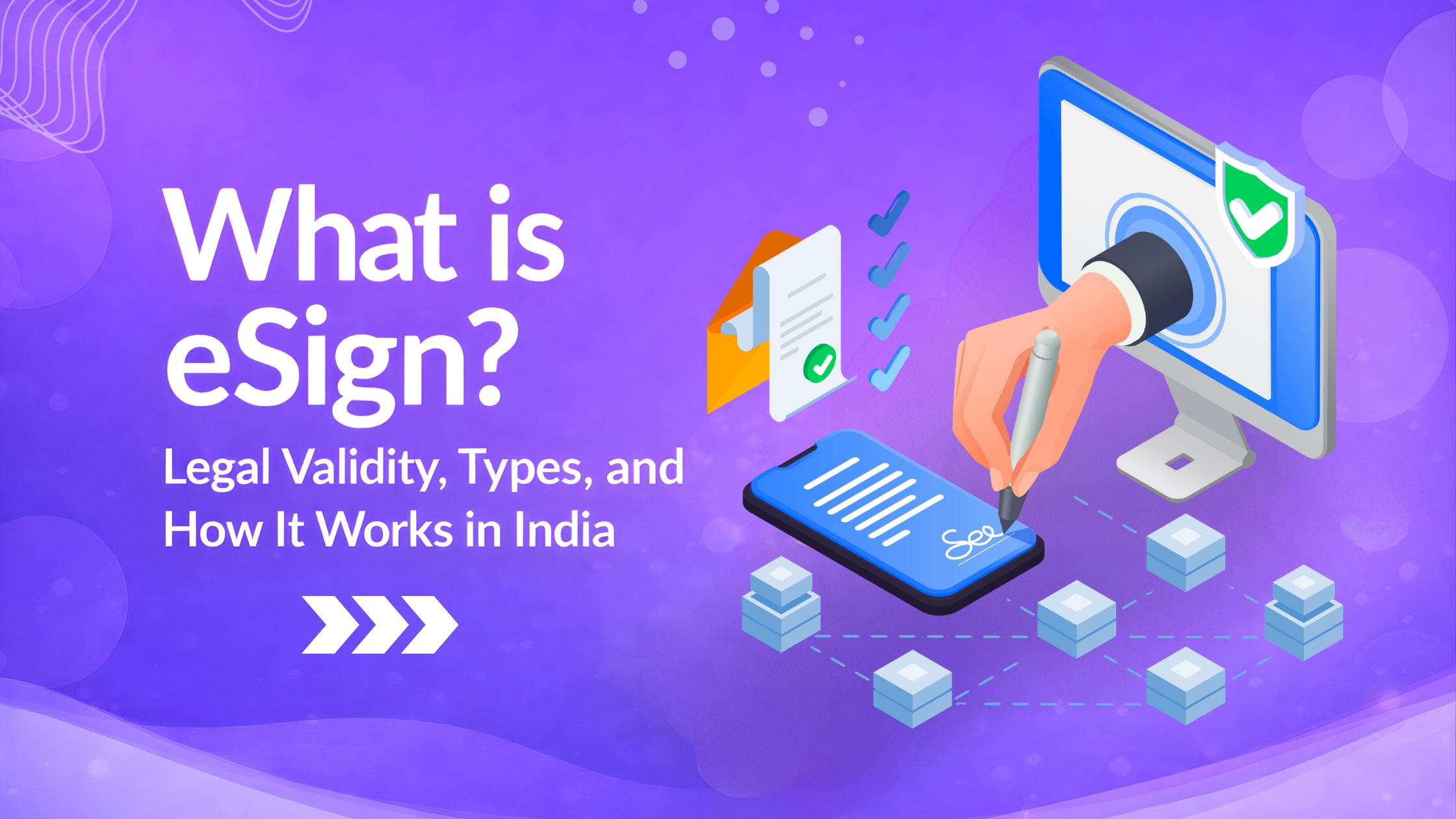
eSign, i.e., electronic signature, is a digital signature for validating and authenticating documents without using physical documents or physical presence with paper. It helps you sign documents while onboarding clients or customers and while accomplishing any agreements or documentation. It is accomplished using Aadhaar-based authentication, OTP verification, and other digital methods.
It is completely different from traditional signatures using pen and paper because the eSign is done electronically and can be completed within seconds. It is widely used for signing agreements, financial documents, KYC processes in banks and NBFCs, etc.
Legal Validity of eSign in India
Most of the people have similar concerns regarding the validity of eSign; is it legally valid in India? For them, it is always assured that electronic signatures are fully recognised and valid as per the Information Technology Act, 2000 (IT Act). However, it must be noted that validity is all about following the guidelines and all.
So, as per the IT Act, 2000:
- eSignatures are considered legally valid if and only if they have been implemented as per the security standards
- Aadhaar-based eSign is always approved by the government because of the database.
- A valid Digital authentication always ensures the identity of the signer
- Documents signed through a valid eSign are also considered legal in court.
As per the above mentioned detail, it says that an electronically signed document holds a similar legal value as a physically signed document.
Features of eSign Services that enhance their Popularity
A robust increase and trends of using eSign Services in India are because of several benefits, and these are as follows.
1. Quick and Timesaving
Your clients/ customers can get the sign-in documents instantly without any usage of physical documents, scanning, etc.
2. Paperless Process
It is enhancing eco-friendly practices, especially by reducing the use of paper and physical documents.
3. Secure Authentication
Most eSign platforms use Aadhaar OTP, biometrics, or digital certificates for verification, which makes it much more reliable.
4. Cost-Effective
It helps in eliminating the costs of printing, physical storage, and logistics burdens.
5. Easy Accessibility
You can sign documents from anywhere through a mobile phone or computer as well.
Types of eSign in India
There are multiple Types of eSign, which are mostly used in India, and it also depends on the types of security level.
1. Aadhaar-Based eSign
Aadhaar-Based eSign is the most commonly used eSign in India, especially when using Aadhaar-based authentication. In this the there are multiple things, such as it uses the Aadhaar number for authentication, OTP is sent to the registered mobile number of the customers, and it is widely used in financial sectors like banking, loans, and KYC.
2. Digital Signature Certificate (DSC)
This is also known as a secure and advanced electronic signature, which is issued by the certifying authorities, and it is mostly used for business, GST, and corporate transactions.
3. Click-to-Sign eSign
This is known as a simple form where users can agree to the terms by clicking a button, and it is commonly used for online agreements. However, it is considered less secure compared to other methods like Aadhaar or DSC.
4. Biometric eSign
In this type, fingerprint or facial recognition for authentication is used. It is known and highly secure. It is often used in government or high-security processes.
Process of eSign in India
Understanding the Process of eSign imparts an insight into how simple and efficient it is, especially in accomplishing the eSign.
Step 1: Upload Document
In the first steps, all the document that needs to be signed is uploaded.
Step 2: Enter Signer Details
The customers/clints provides signer provides necessary details like name, Aadhaar number, or email ID.
Step 3: Authentication
Once uploaded, the system verifies the identity of the signer using OTP, which is sent to the Aadhaar-linked mobile number.
Step 4: Apply eSignature
After verification, the electronic signature is done in the document.
Step 5: Completion and Download
The signed documents are generated, which can be downloaded or shared instantly.
Uses of eSign in India
Since eSign has become a significant tool in various sectors like banking, finance, business and corporate, etc, some common uses can be including of :-
1. Banking and Financial Services:
It can be used in Loan agreements, Account opening forms, and in the KYC verification as well.
2. Business and Corporate Sector
While accomplishing Contracts and agreements, getting Vendor approvals or HR documentation, it can be used.
3. Government Services
In government services, it can be used in multiple fields like online applications, Digital certificates, and public service forms as well.
4. Real Estate
In real states, multiple functions can be accomplished through this, like Rental agreements, Property documentation, etc.
5. Education Sector
In the education sector, it is widely used in Admission forms, while issuing certificates and approvals, etc.
Some Specific Security Features of eSign
Since data security is a major concern in the digital world, eSign secures the security for most of the platforms, and these are
- Encryption of documents: The documents are encrypted, which makes them secure.
- Secure authentication methods: Using Aadhaar-based authentication maintains security.
- Track signing activity: All the signing activities are monitored regularly.
Limitations of eSign
Using eSign helps you ensure enormous benefits, but there are a few limitations that must be considered, and a couple of them are as follows.
- Requires internet access at all times, especially while performing the services.
- The mobile number must be linked to the Aadhaar
- Lack of digital literacy and awareness can be the challenges in rural areas. However, with the digital adoption, it can be beneficial and can be used widely.
Conclusion
eSign is transforming signature methods in India by reducing multiple resources and human efforts. With the approval of the IT Act and the availability of secure eSign Services, it has been becoming a reliable solution which has been enhancing efficiency.
So, understanding the Process of eSign and the different Types of eSign helps you adopt this technology for your usage. Depending on your business needs you can select the best services for the enhancement of your business.


Leave a Reply